

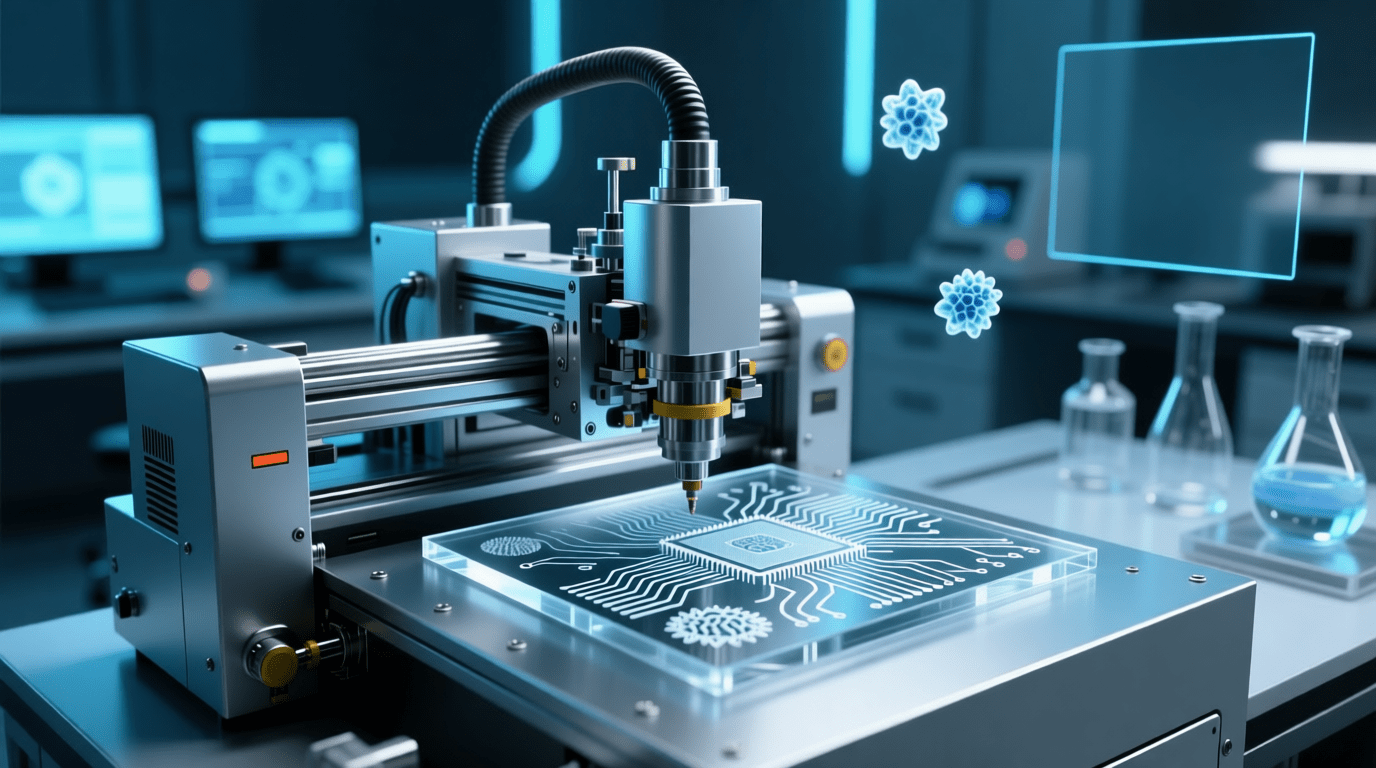
Dolgoprudny, Russia – Researchers at the Moscow Institute of Physics and Technology (MIPT) have developed an advanced laboratory lithographic complex, a versatile device designed to create microscopic patterns on a wide array of materials, pushing the boundaries of traditional semiconductor manufacturing into the realms of biophysics and photonics.
Beyond Silicon: A Multi-Method Tool for a New Era
At its core, lithography is the fundamental process of patterning surfaces, crucial for manufacturing computer chips. The uniqueness of the MIPT complex lies in its ability to transcend this traditional role. It is engineered to work not only with semiconductors but also with delicate biological objects, such as living cells, and specialized photonic structures used for manipulating light at a microscopic level.
This is achieved by integrating several lithography methods, including laser lithography and electron beam lithography, into a single, unified platform. This hybrid approach allows scientists to select the most appropriate technique for a specific material or application, from writing conductive nanowires to creating scaffolds for cell growth or etching waveguides for light.
The AI-Powered Microscope: Intelligence at the Micro-Scale
A key innovation that sets this complex apart is its integration of a high-precision microscope enhanced with artificial intelligence (AI). This system does not merely view the substrate; it intelligently analyzes it. The AI can automatically locate, identify, and analyze objects on the surface, such as individual cells or pre-existing structures.
This capability dramatically accelerates and simplifies the lithography process. Instead of a scientist manually aligning patterns, the system can automatically target specific cells for modification or ensure a new photonic structure is perfectly aligned with an existing one. This reduces human error and opens the door to high-throughput, automated experiments that were previously impractical.
Pioneering Research at MIPT
The development is led by chief designer Danila Kolymagin, head of the optical lithography design bureau at MIPT. The institute, often called “Russia’s MIT,” is renowned for its rigorous training in theoretical and applied physics. This project is a testament to its focus on interdisciplinary research that bridges fundamental science with tangible engineering solutions.
MIPT’s Phystech School of Electronics, Photonics, and Molecular Physics has several laboratories dedicated to nano- and micro-system technology, providing the ideal ecosystem for such a development. The complex aligns with global trends in scientific instrumentation, where flexibility, multi-functionality, and automation are increasingly valued.
Potential Applications and Global Context
This type of versatile lithography system has significant implications across multiple fields:
-
Biomedical Engineering: Creating precise microscopic environments to study cell behavior, developing advanced biosensors, and engineering lab-on-a-chip devices.
-
Photonics and Optoelectronics: Fabricating novel optical circuits, metamaterials, and sensors that can control light in ways traditional optics cannot.
-
Advanced Materials Science: Developing new materials with customized electrical, optical, or mechanical properties at the nanoscale.
While major global players like Heidelberg Instruments and JEOL dominate the market for specialized lithography tools, the MIPT complex distinguishes itself through its deliberate multi-disciplinary design and integrated AI, positioning it as a powerful tool for academic and industrial research requiring high flexibility.
This development from MIPT represents a significant step in Russia’s scientific capabilities, offering a platform for innovation that could foster international collaboration in cutting-edge fields like biophysics, quantum technology, and advanced materials science.