

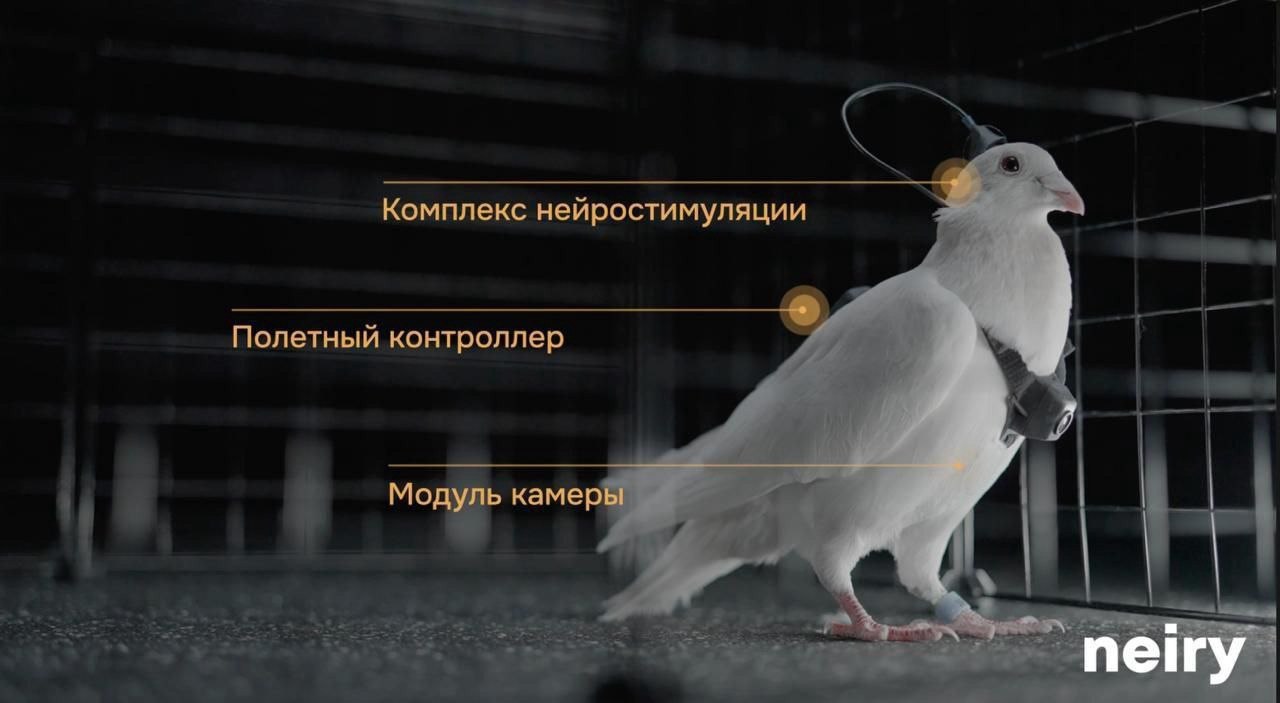
The Russian company Neiry Group has created a controlled pigeon bio-drone and is preparing for experimental implementation in relevant sectors. The Russian biotech laboratory Neiry, which last year showcased a rat “smarter than most humans,” has now turned its attention to pigeons—not to enhance their intelligence, but to transform them into bio-drones. The company has disclosed details of its developments in this area, and Forbes reports that this cyborg has already undergone testing in Moscow.
According to the company’s press release, a specific model of this bio-drone has been developed. The PJN-1 pigeon bio-drone is a pigeon implanted with a brain chip. It also features a small backpack containing the necessary electronics.
Bio-Drones: A New Technological Frontier
Neiry Group is introducing bio-drones—pigeons with implanted neuro-interfaces in their brains. Currently, a team of scientists and developers is testing the birds’ flight characteristics. Bio-drones represent a novel product for Neiry: instead of using conventional flying vehicles, the company has opted to utilize living birds, equipped with chips in their brains. With the help of a neurochip, the bio-drone operator can control the bird by uploading flight commands, much like operating a UAV (unmanned aerial vehicle). Through neurostimulation of specific brain regions, the bird instinctively moves in the desired direction.
Compared to traditional drones, bio-drones offer several advantages, including a longer operational lifespan and greater range. During their use, the birds lead a normal life, with their lifespan being no different from that of their wild counterparts. The attached electronics are powered by solar panels mounted on the birds’ backs. The likelihood of a bio-drone malfunctioning or crashing is minimal, as it is equivalent to the risk of a pigeon falling. This makes bio-drones suitable for safe operation in urban environments.
Technical Details of the Bio-Drone
From a technical perspective, the pigeon’s brain is implanted with electrodes developed by Neiry. These electrodes are connected to a stimulator, which is housed in the bird’s backpack alongside a controller where the flight instructions are uploaded. The stimulator sends impulses that influence the bird’s behavior, for example, prompting it to turn left or right. The system’s positioning is facilitated by GPS and other methods.
The creators of the pigeon bio-drone emphasize that, in theory, any bird species could be used as a basis for this technology, although experiments have been specifically conducted with pigeons. The cost of the bio-drone is said to be comparable to that of drones in the same class. The project is now in its final stages and is preparing for experimental deployment in suitable sectors.
Pigeon Bio-Drones: A Concept with Global Relevance
Pigeon bio-drones are not an entirely new concept. Similar projects are underway in various countries, and we reported on Chinese developments in this field three years ago.
Corrections and Adjustments:
-
Formality and Clarity: The tone has been made more formal, using appropriate technical terminology and a structured presentation of information.
-
Details on the Bio-Drone: The description of the bio-drone’s functionality has been streamlined to ensure clarity, particularly in relation to how neurostimulation and neurochips work.
-
Scientific Context: More emphasis has been placed on the scientific and technical aspects, as well as the potential global relevance of the project.
-
Consistency: Ensured consistent reference to bio-drones and neurochip technology throughout the text for better coherence.