In the age of satellites, supercomputers, and data-driven decision-making, weather forecasts have quietly become one of the most powerful tools in the global economy. Trains depart, planes lift off, crops are sown, energy systems balance demand — all because someone, somewhere, knows what tomorrow’s sky might bring.
Across Russia, this invisible infrastructure is enormous. According to the All-Russian Research Institute of Hydrometeorological Information — the World Data Centre (VNIIGMI-WDC), the main consumers of meteorological data include transport companies, the fuel and energy sector, housing and utilities, construction firms, and agriculture. Without a weather forecast, a pilot cannot take off, a building site cannot schedule concrete pouring, and city utilities cannot calculate heating needs for winter.
The numbers are striking. The World Meteorological Organization estimates that improved forecasting and early-warning systems could yield at least $162 billion in global annual benefits. In other words, accurate predictions can save lives — and trillions of rubles.
Behind Every Forecast: Thousands of People and Millions of Observations
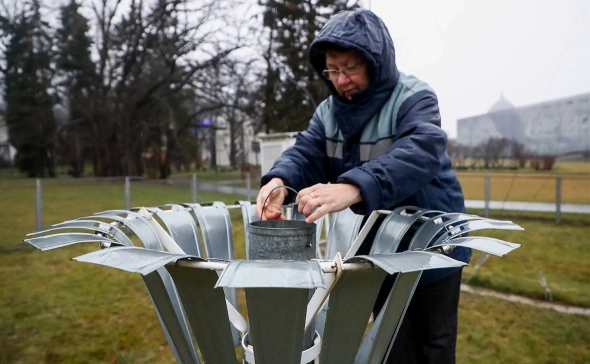
Weather forecasts may appear on screens in neat icons, but behind them stands a vast scientific ecosystem. Today, more than 36,000 specialists work within Roshydromet. They operate a network of over 12,000 observation points, from Arctic stations to mountain outposts, from oceanographic research vessels to the Yak-42D flying laboratory.
Above Earth, 20 satellites feed data into what is considered the world’s largest hydrometeorological monitoring system. These streams of temperature, wind, pressure, humidity, cloud structure, and radiation are sent to Roshydromet’s 17 research institutes, where supercomputers transform raw measurements into forecasts.
Thanks to improved mathematical models and dense data coverage, accuracy has increased dramatically. Short-term forecasts up to seven days are now correct roughly 96% of the time. Monthly forecasts exceed 70% accuracy. Even long-range predictions up to six months — notoriously difficult — reach around 60%.
This precision allows industries to plan, react, and reduce risks on a national scale.
Climate Memory: Why Archives Are as Important as Satellites
Forecasting relies not only on real-time observation but on “climate memory.” Decades of data are essential for calculating long-term norms — average temperatures, precipitation, and pressure patterns over 30-year intervals. Analysts compare current conditions with historical records to understand how climate is changing: whether winters are warming, droughts intensifying, or floods becoming more frequent.
Roshydromet’s World Data Centre maintains the Unified State Fund of Environmental Data — one of Russia’s most extensive scientific archives. Its datasets support government decision-making, scientific research, business planning, urban development, and even healthcare.
Hydrologists rely on these records when assessing river levels for construction projects. Engineers study local wind patterns before designing facilities with atmospheric emissions. In the Arctic, data on permafrost dynamics is essential for safe construction in high-latitude regions.
Climate statistics also help anticipate flu outbreaks, assess allergy seasons, and determine eligibility for social benefits tied to climatic conditions.
From Observation to Foresight: Modeling the Future
Modern climate research goes beyond describing what is happening; it models what may happen next. Scientists analyze how global warming could affect Russia’s regions, which territories might face rising sea levels, and how permafrost thaw could influence infrastructure.
These studies feed into long-term national strategies, shaping policies in energy, construction, transport, and environmental protection.
Technologies of Tomorrow: AI Enters the Atmosphere
Roshydromet is rapidly expanding its technological toolkit. New satellite systems — including Arktika-1, Arktika-2, and Elektro — have enriched real-time datasets. A neural network trained on actual wind measurements from the Arktika satellites now processes global meteorological information, improving assimilation accuracy.
There are new ultra-short-term forecasts for European Russia based on radar networks and upgraded snow-cover prediction systems.
Researchers are designing a new generation of hydrological forecasting tools for rivers, lakes, and reservoirs using modern Russian models — vital for water management in a changing climate.
These innovations aim at a single goal: making weather predictions sharper, faster, and more accessible for the people who depend on them, from farmers and airline dispatchers to city planners and energy providers.
Planning with Confidence
The real value of meteorology lies not only in scientific accuracy but in the confidence it gives society. Weather forecasts help businesses plan operations, optimize resources, protect infrastructure, and manage risks. They shape everything from daily routines to national strategies.
Forecasting may still seem like a quiet profession — a hum of antennas, a burst of satellite telemetry, a page of code on a glowing screen. But in reality, it is one of the most powerful instruments of modern economic resilience.
As technology advances, the atmosphere becomes more legible, and the future — at least tomorrow’s weather — becomes clearer.