

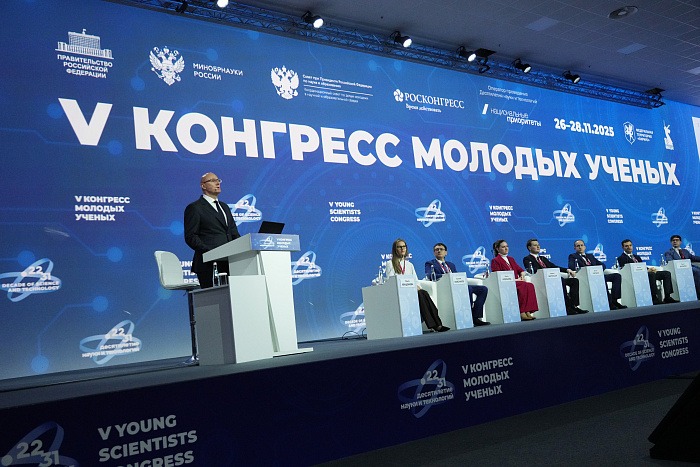
The 5th Congress of Young Scientists concluded at the Sirius Science and Art Park in Sochi, marking the largest scientific forum held in Russia over the past five years. The event brought together more than 8,000 participants from 89 Russian regions and 100 countries, representing 524 universities worldwide. The Congress offered compelling evidence that Russian science remains a strong, open, and globally relevant force—capable of tackling humanity’s most pressing challenges.
A Platform for Integration: From Ideas to Real Projects
The Congress served as a dynamic meeting point where science, industry, and technology-driven business converged. Across more than 550 sessions, including discussions, lectures, and workshops organized under four thematic tracks—Grand Challenges, Initiatives of the Science Decade, Future Potential, and International Cooperation—participants launched tangible projects and forged new partnerships.
A concrete outcome of these interactions was the signing of 47 significant agreements among companies, research institutes, and universities—laying the groundwork for future breakthrough innovations and their commercialization.
“Science has always been, and remains, beyond politics—a powerful unifying force for all of humanity. Here at this Congress, we see that force actively driving progress and creation,” said Russian President Vladimir Putin in his address to the forum.
Russian Technologies Shaping the Future: From Medicine to Space
A major highlight of the Congress was a large-scale exhibition featuring hundreds of cutting-edge developments, many of which are already market-ready for global deployment. Experts and attendees identified several standout areas:
Medicine and Biotechnology
- A portable bioprinter for regenerating skin in severe burn and trauma cases.
- An intelligent foot prosthesis with microprocessor control that adapts to the user’s gait.
- A focused ultrasound technique for non-invasive, precise tumor ablation.
- A digital capillaroscope enabling early diagnosis of vascular disorders.
Energy and Environmental Solutions
- Rosatom’s closed nuclear fuel cycle technology, which addresses radioactive waste and provides a near-limitless source of clean energy.
Space and Advanced Equipment
- Serial-production Russian propulsion systems for small satellites (CubeSats).
- A portable lab sensor capable of performing complex chemical analyses in field conditions.
- Modern laboratory equipment for schools, empowering students to engage in real scientific work from an early age.
Clear Signals for Global and Indian Collaboration
The Congress and its showcased innovations send strong messages to the international—and particularly the Indian—scientific and business communities:
- Russia is an open partner for joint R&D. The significant presence of scientists from Asia, the Middle East, Africa, and Latin America demonstrates Russia’s commitment to scientific and technological cooperation in a changing geopolitical landscape. For India, this opens opportunities to become a key ally in co-developing technologies in AI, biomedicine, clean energy, and space.
- Market-ready innovations. Many of the featured technologies—including medical devices, diagnostic tools, and educational solutions—have direct commercial potential and can be readily adapted to meet India’s specific needs. This creates a solid foundation for direct investment, licensing deals, or joint manufacturing.
- Access to world-class expertise. Russia’s enduring strength in fundamental disciplines—mathematics, physics, chemistry, and engineering—continues to fuel applied innovation. Establishing joint laboratories or engaging Russian specialists could offer Indian companies a significant competitive edge.
- Strong govt-level support. The scale of the Congress and the personal involvement of national leadership underscore that science and technology are top national priorities, ensuring long-term institutional backing for collaborative ventures.
Our understanding of the current trend is as follows. Far from being isolated, Russian science is experiencing a renaissance—and is opening new avenues for cooperation with the Global South. For India, which is advancing its own vision of technological sovereignty, partnering with Russia represents a strategic choice: one that combines intellectual resources to drive breakthroughs in critically important sectors.
In essence, the Congress was far more than a showcase of achievements—it was a powerful demonstration of Russia’s readiness to share future-shaping technologies and to co-create more inclusive, equitable models of international scientific and technological collaboration.