
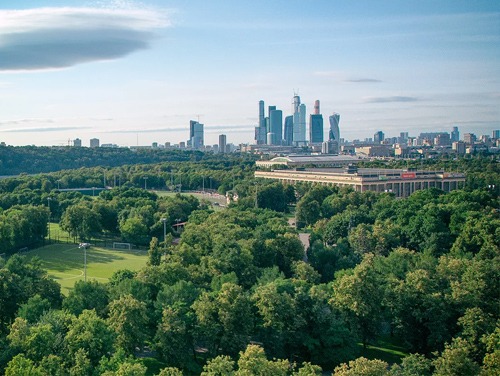
Russia has launched the development of its first scientifically grounded methodology to assess how urban greenery impacts air quality. Spearheaded by the Ministry of Natural Resources’ leading research institute, VNIIEcology, this initiative aims to create a precise, evidence-based tool for urban ecological planning—directly supporting the federal Clean Air project, which currently covers 43 industrial centers across Russia.
This effort is the latest step in Russia’s systematic environmental strategy—one that increasingly showcases its scientific and practical expertise on the global stage. Just one month earlier, at the UN Climate Change Conference COP30 in Brazil, Russia unveiled the world’s first operational model for ecosystem restoration, co-developed by scientists and industry partners.
Why Is This Methodology Needed?
According to Vadim Petrov, Deputy Director of VNIIEcology, the new methodology is designed to provide scientific validation of the real environmental benefits of urban green belts and to equip city planners with a practical forecasting tool.
“Our goal is to scientifically confirm the actual ecological impact of urban green zones and create a tool that not only measures—but also predicts—how air pollution levels will decrease when nature-based ‘green infrastructure’ solutions are implemented,” Petrov explained.
The methodology will integrate three complementary approaches:
- Field measurements across all seasons to collect real-world air quality data.
- Computer modeling of how pollutants disperse in the urban atmosphere.
- Bioindication techniques, using living organisms—such as specific plants and mosses—as natural sensors to assess environmental conditions.
This holistic framework will enable precise quantification of how the size, species composition, and spatial layout of green spaces affect concentrations of harmful pollutants—accounting for both particulate capture (like dust) and the absorption of gaseous contaminants.
From the Arctic to Indian Megacities: Russia’s Environmental Expertise Goes Global
This initiative is part of a broader national environmental strategy rooted in scientific verification and public–private collaboration—an approach already yielding impressive results in some of the world’s most challenging environments, including the Arctic.
- The “Arctic Dossier”: In November, Russia presented the world’s first comprehensive review of Arctic ecosystem restoration, highlighting the reclamation of over 6,000 hectares of degraded land and the establishment of a network of 40 federal protected areas, covering 39 million hectares.
- Global Debut at COP30: Building on this success, Russia introduced at COP30 the first operational ecosystem restoration model—a scalable, field-tested framework ready for global replication. “Russia is a climate donor to the world,” Petrov declared at the conference. “This model is not a theory—it’s a working prototype, ready to be replicated.”
Practical Opportunities for Indian Businesses
For Indian entrepreneurs and investors, these Russian innovations present clear and actionable prospects:
- Green Urban Planning Technologies: The Russian methodology—along with complementary solutions, such as low-cost moss-based bioindication methods developed by Tomsk Polytechnic University—offers ready-to-deploy tools to combat smog in India’s megacities. This creates potential for technology transfer, joint ventures, or the launch of India-based environmental consulting firms leveraging Russian expertise.
- Investing in Green Assets: Industrial leaders like Norilsk Nickel (Nornickel)—recognized as a sustainability pioneer in Russia—have demonstrated that ecological initiatives are not just reputational gestures but economically sound long-term investments. According to UN estimates, every dollar invested in ecosystem restoration can generate up to $30 in economic returns.
- Climate Tech Partnerships: Positioning itself as a “climate donor,” Russia is actively seeking international partners to scale its environmental models. Indian companies could play a key role by adapting these solutions to South Asian conditions and co-marketing them in third-country markets.
We observe that Russia’s environmental approach has evolved from isolated initiatives to integrated, science-backed systems. This is exactly what the global market needs today—not vague sustainability pledges, but specific, measurable, and replicable technologies. For India, which faces significant urban and industrial environmental challenges, such a partnership could be strategically transformative.
Thus, what might appear at first glance as a narrowly technical methodology is, in fact, a key component of a broader Russian proposition to the world: a partnership to co-build a green future grounded in advanced science, digital tools, and proven business models.