

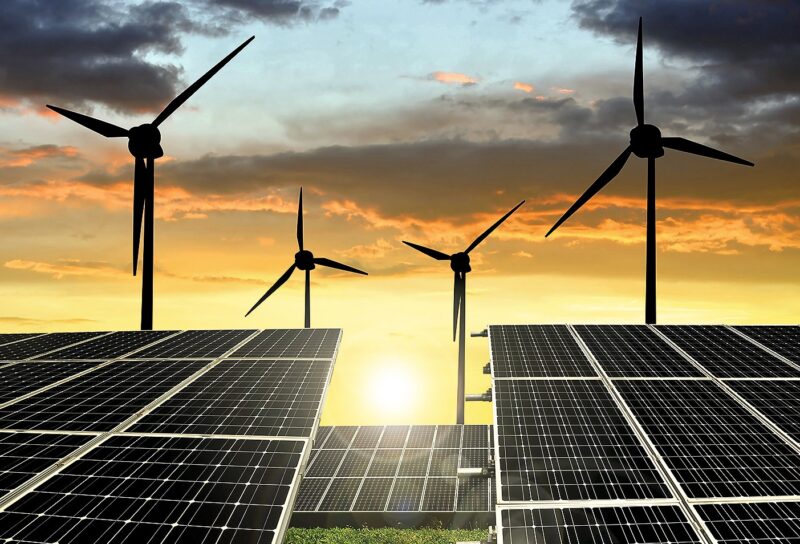
In a strategic pivot aimed at powering its future, Russia is embarking on a massive state-driven expansion of its renewable energy sector. The effort is not merely about installing solar panels and wind turbines, but about building an entirely new, sovereign industrial ecosystem—from raw materials to megawatt-scale systems. This initiative is unfolding under the umbrella of the national project “New Nuclear and Energy Technologies,” with ambitious targets to achieve near-total technological independence.
The push comes as global electricity demand is forecast to surge by up to 100% by 2050, with Russia’s own consumption expected to grow steadily at 1.2% annually. To meet this demand with a reliable and flexible system, the country’s energy strategy is evolving towards a hybrid model. The bedrock of stable supply will continue to be traditional thermal, nuclear, and hydroelectric power. They are now slated to be complemented by a significant ramp-up in renewables, which currently account for a mere 2.6% of the national energy mix.
Wind Power Takes the Lead
The growth trajectory for renewables is steep. Deputy Prime Minister Alexander Novak has stated that Russia aims for renewables to constitute 10% of its energy balance by 2030. The installed capacity of such plants is projected to leap from today’s 6 gigawatts (GW) to 20 GW by 2035.
State nuclear corporation Rosatom, through its subsidiary Rosatom Renewable Energy, is emerging as the dominant force in this expansion, particularly in wind energy. It already operates 10 wind farms across regions like Stavropol Krai and Rostov Oblast. A landmark project is the Novolakskaya Wind Farm in Dagestan. Its first phase (152.5 MW) is operational, and upon completion of a second phase in 2026, its total capacity of 300 MW will make it the country’s largest.
Looking ahead, plans include the construction of the Uspenovskaya Wind Farm in the Far East, with a projected capacity of up to 400 MW.
The Real Story: Domestic Industrialization
The most significant aspect of this expansion is the parallel creation of a localized manufacturing chain. Viktor Svistunov, Deputy General Director of Rosatom Renewable Energy, emphasized that localization for their wind farms has already reached 85%. “All key components of a wind turbine are produced in Russia,” he stated.
This has spurred the development of a sophisticated supply network:
- A plant in Volgodonskserially produces up to 120 sets per year of critical components like nacelles and generators.
- In Ulyanovsk, a state-of-the-art facility manufactures enormous 51-meter composite blades, using domestically sourced glass and carbon composites from a new plant in Vladimir Oblast.
- Over 250 Russian enterprisesare now part of Rosatom’s industrial cooperation for wind turbine parts.
- To secure the supply chain for generators, Russia is mastering the production of permanent rare-earth magnets, with full-cycle production from local minerals targeted for 2027.
Solar and Storage: Building the Full Stack
The strategy extends beyond wind. The goal of 90% technological independence by 2030 also applies to solar energy. A cornerstone of this effort is the Encore industrial complex in the Kaliningrad Oblast, hailed as the largest of its kind in Europe. It integrates the production of monocrystalline silicon ingots and wafers with the manufacture of high-efficiency heterojunction solar cells.
Crucially, the national project recognizes that a modern grid requires robust storage. It mandates the creation of new technologies for lithium-ion and next-generation energy storage systems. To this end, “gigafactories” for battery production are under construction in Moscow and Kaliningrad Oblast. These facilities are projected to produce over 100,000 lithium-ion battery units annually, aiming to satisfy the needs of the energy and transport sectors completely.