
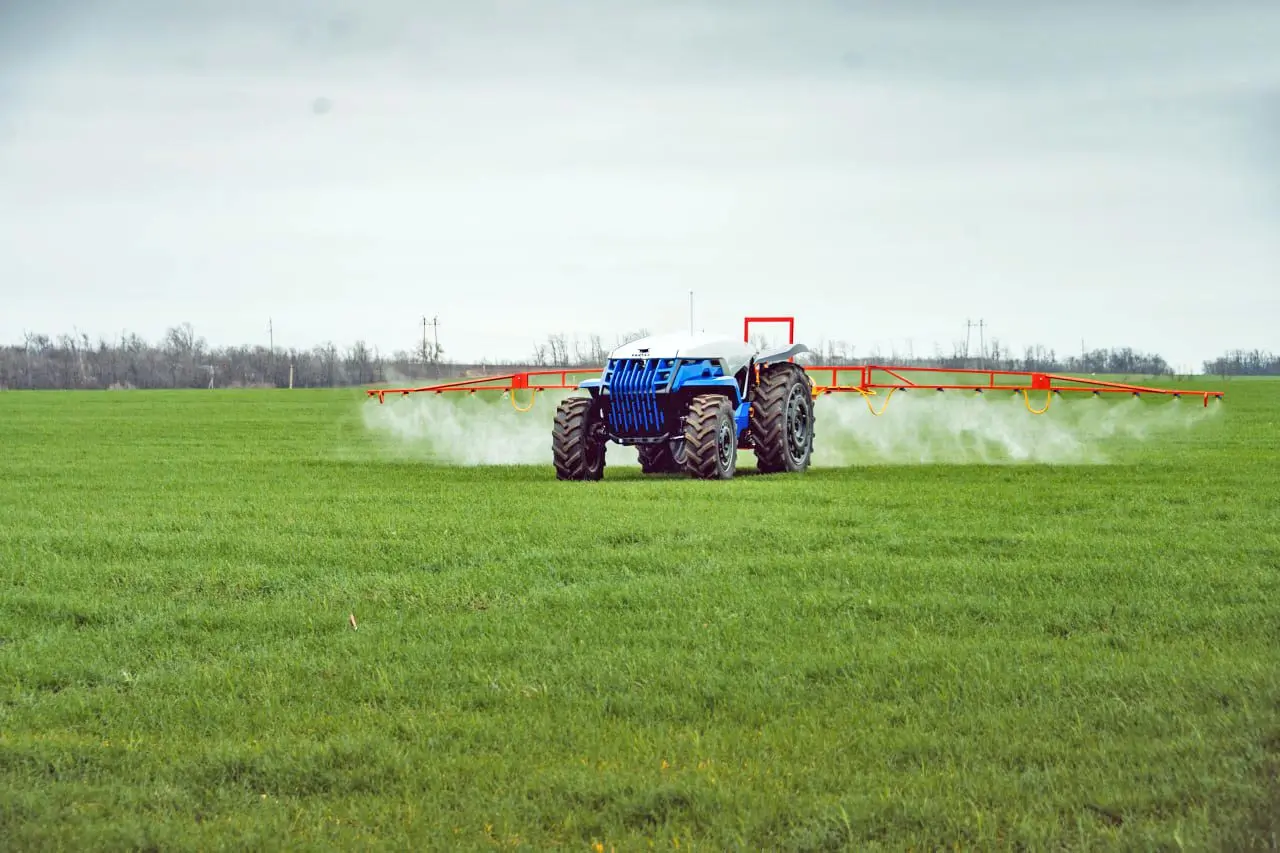
Russia has successfully tested the “Dontech” unmanned tractor, marking a significant advance in autonomous farming technology that directly applies military communications systems to agricultural equipment.
Developed jointly by Don State Technical University (DSTU), Moscow Polytechnic University, and agricultural machinery giant Rostselmash, the prototype combines a hybrid power system, pneumatic braking, and tablet-based control with an experimental synchronous electric motor featuring an axially positioned magnetic field.
Military Technology Meets the Farm
What distinguishes this project is its integration of interference-resistant communication systems originally developed for Russian military robotic complexes and drones. This technology addresses a critical challenge: operating autonomously without internet connectivity.
“In Rostov Region, there is serious interference affecting the internet, which can negatively impact the machine’s connection with satellites and other systems. Therefore, technologies are being developed that allow controlling the vehicle without internet and connection to external systems,” explained Vladislav Pigenko, Director of DSTU’s Engineering School.
This internet-independent architecture solves a vulnerability that affects autonomous equipment worldwide—particularly in conflict zones, remote areas, or regions with unreliable infrastructure.
Performance and Versatility
Engineers claim the Dontech can process 1.5 to 2 times more area per shift than conventional tractors, thanks to precise movement control and minimized auxiliary operations. The hybrid system enables continuous 24-hour operation, with battery capacity providing approximately two hours of electric-only running time. Recharging takes between ten minutes and four hours depending on the operational mode.
Field trials covered irrigation and plant protection applications, but engineers emphasize the platform’s potential extends beyond traditional farming to construction, road maintenance, and municipal operations—expanding its commercial viability across multiple sectors.
From Prototype to Production
The Dontech currently exists as a single prototype for testing navigation precision, autonomous capabilities, and computer vision systems. Engineers plan to modernize the hybrid engine system next year with a specific goal: making the technology accessible to small agricultural enterprises, not just large agribusiness.
The development builds on Rostov Region’s 2017 testing of Russia’s first unmanned grain harvester, which could navigate field boundaries automatically but still required human operators for parameter adjustments. The progression illustrates evolving sophistication in autonomous farming technology.
Strategic Context
The project reflects converging priorities in Russian technology development. With Western agricultural equipment manufacturers having largely exited the Russian market, domestic development of advanced farming machinery addresses both economic and strategic imperatives.
For Russia’s agricultural sector—maintaining productivity despite geopolitical isolation from Western technology suppliers—indigenous development of autonomous equipment represents strategic necessity, not merely technological advancement.
Challenges Remain
Significant hurdles stand between successful prototype and commercial deployment. The stated focus on accessibility for small enterprises suggests current costs remain prohibitive. Battery technology, sophisticated sensors, and custom electric motors typically carry premium price tags requiring substantial reduction for broad adoption.
Technical maturation demands extensive field testing across varying conditions and soil types. Farms must also adapt operations, maintenance capabilities, and workforce skills—organizational changes often more challenging than the technology itself.
Whether the Dontech evolves from experimental prototype to practical farming tool depends on continued engineering refinement, cost reduction, and development of supporting ecosystems for maintenance and training.