


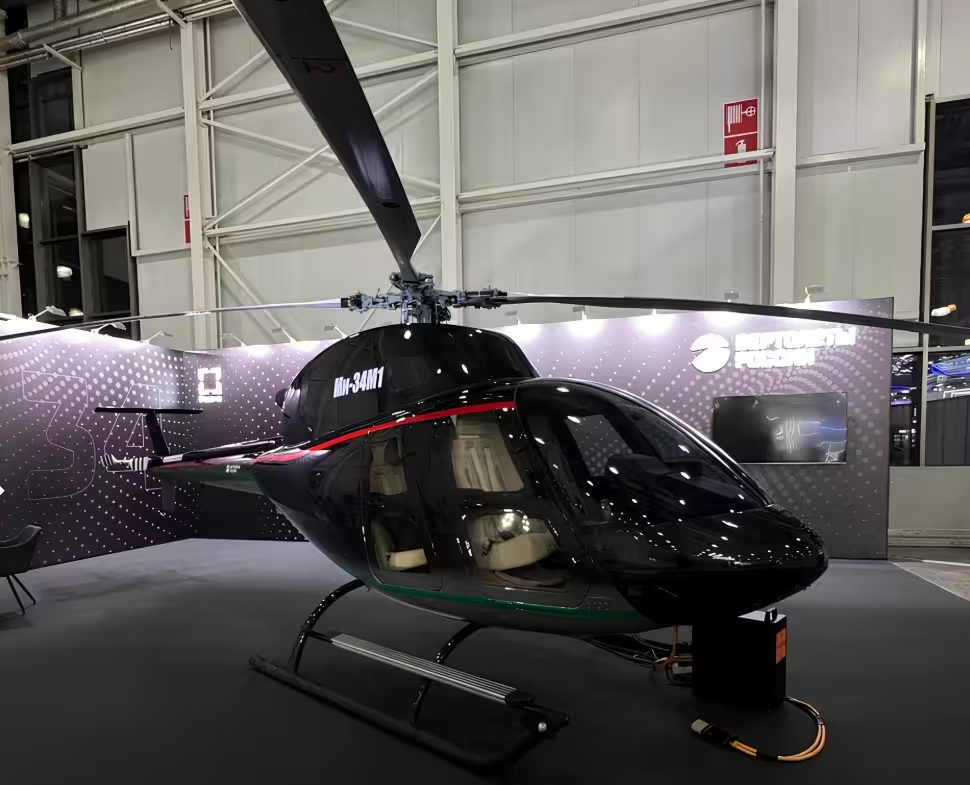
Russian Helicopters showcased its updated Mi-34M1 light aircraft this week at the National Aviation Infrastructure Show (NAIS 2026) in Moscow. The public presentation, held on February 4–5, marks a key stage in the manufacturer’s effort to re-enter the light utility market with a platform built entirely from domestic components. For the Russian aerospace sector, the Mi-34M1 is being positioned as a replacement for Western models that have historically dominated the small-scale aviation segment but are now increasingly difficult for local operators to maintain.
The project addresses a significant supply gap created by the withdrawal of manufacturers like Robinson, Bell, and Airbus. Since 2022, local flight schools, private carriers, and government agencies have faced rising costs and logistical hurdles in sourcing certified spare parts for foreign fleets. By transitioning to a homegrown platform, the industry aims to stabilize operations for essential services such as infrastructure monitoring, pilot training, and regional logistics, which no longer have access to official technical support from Western brands.
A core technical update to the Mi-34M1 is the integration of the VK-650V gas turbine engine, which replaces the older piston-driven powerplants. Developed by St. Petersburg-based ODK-Klimov, this 650-horsepower engine received its official certification in late 2024. The unit includes a digital automatic control system—often referred to as FADEC—which manages all engine parameters during flight to improve reliability. This shift to turbine power is expected to provide more consistent performance and simplified maintenance compared to the mechanical complexity of earlier versions.
The helicopter’s operational capabilities were recently validated during a 10-minute maiden flight on December 30, 2025. Designed to carry one pilot and three passengers, the aircraft reaches a maximum speed of 220 kilometers per hour. Its compact design is specifically tailored for landing on small, unprepared clearings, a requirement for missions in remote regions where traditional airport infrastructure is nonexistent. While the platform is based on a legacy design from the late 1980s, the current modernization focuses on integrating modern avionics and crash-resistant fuel systems to meet current safety standards.
Serial production is being organized at the Kazan Helicopters plant, with assembly lines currently being prepared for the first batch of aircraft. Rostec, the state corporation overseeing the program, indicates that the use of domestic materials is intended to shield the production schedule from international trade restrictions. While the initial focus is on fulfilling domestic demand for government and educational use, the manufacturer is also exploring the export potential of the Mi-34M1 for markets requiring rugged, low-maintenance aircraft for utility and sport aviation.

