

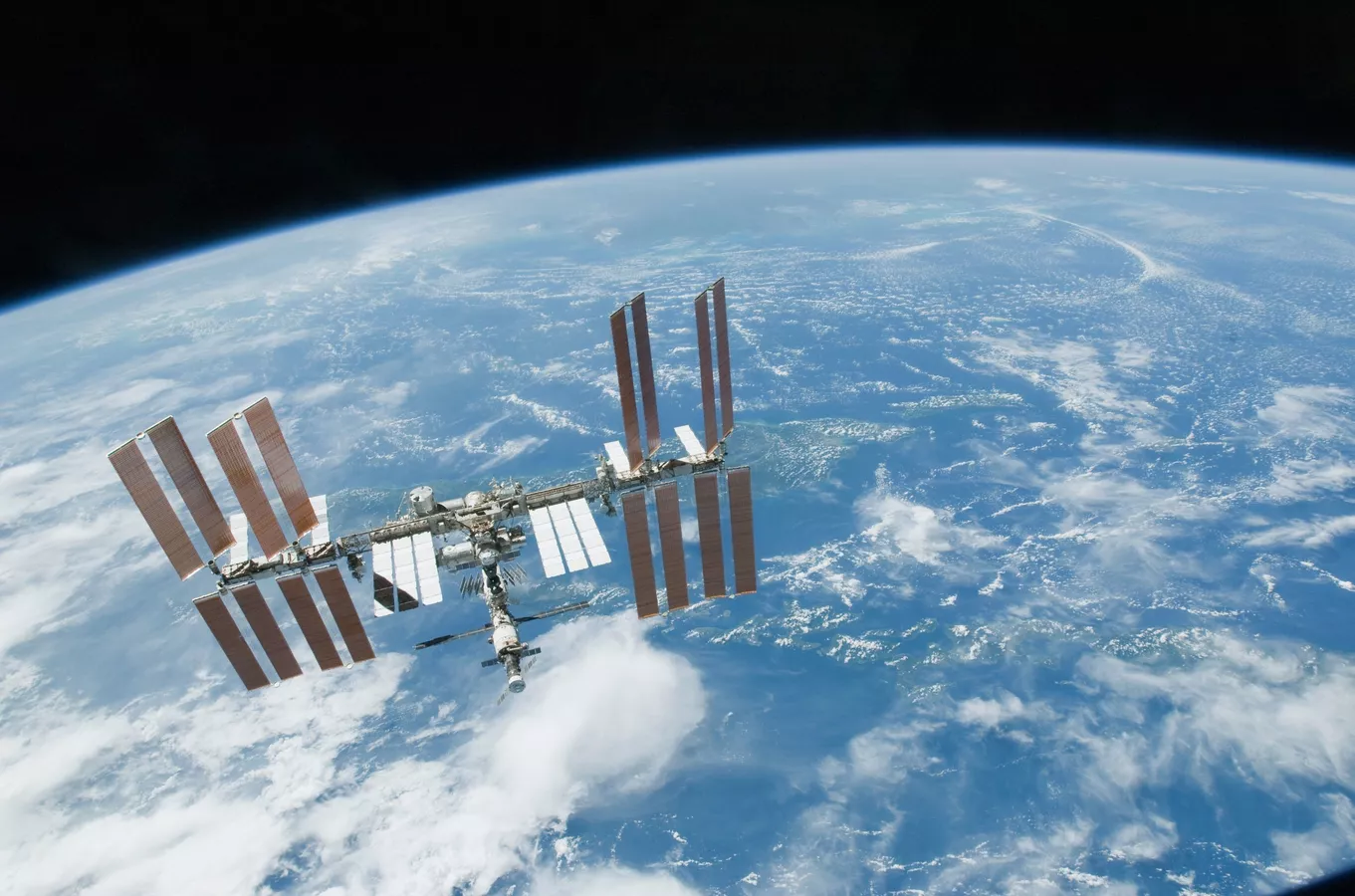
In an era when the world is gradually embracing a more multipolar scientific landscape, space remains one of the rare domains where nations still extend hands across borders. The latest example came this week as Russia’s Soyuz MS-28 spacecraft successfully docked with the International Space Station (ISS), reaffirming humanity’s shared future beyond Earth.
The launch unfolded at Kazakhstan’s historic Baikonur Cosmodrome, a site well-known to Indian space enthusiasts as the birthplace of the world’s first human spaceflight. At precisely 12:28 Moscow time, a Soyuz-2.1a rocket ignited, sending the crewed spacecraft into orbit. In just under nine minutes, the ship reached its designated trajectory and began a remarkably swift two-orbit rendezvous with the ISS — a technique perfected by Russian mission planners over the past decade.
A Crew That Reflects Today’s Global Space Community
On board Soyuz MS-28 were two seasoned Roscosmos cosmonauts — Sergey Kud-Sverchkov and Sergey Mikayev — joined by NASA astronaut Christopher Williams. Their arrival highlights something India has long appreciated: even when Earthly politics shift, human curiosity and the pursuit of knowledge often bridge divides.
A few hours after docking, the crew will open the hatches and join an already diverse team orbiting 400 km above Earth:
-
Russian cosmonauts Sergey Ryzhikov, Alexey Zubritsky, Oleg Platonov
-
American astronauts Jonny Kim, Zena Cardman, Michael Fincke
-
JAXA astronaut Kimiya Yui
Together, they represent continents, cultures and scientific schools working toward a single shared mission — expanding humanity’s understanding of microgravity, biology, materials science and long-duration spaceflight.
Why This Matters for India
India, today one of the world’s fastest-rising space powers, has an especially rich appreciation for such milestones. From ISRO’s lunar successes to its interplanetary missions, India knows better than most that progress in space is built on patience, engineering excellence and participation in a global scientific dialogue.
Russia’s continued activity in crewed missions — especially using the Soyuz platform, famous for its reliability — maintains an important pillar of the international space architecture. For Indian readers, this symbolizes several broader trends:
1. A multipolar scientific world in action
The ISS remains one of the most enduring examples of scientific cooperation transcending geopolitical complexity. Missions like Soyuz MS-28 underscore that multiple nations can participate meaningfully in global exploration.
2. Long-term opportunities for India–Russia cooperation
India and Russia have a decades-long history of collaboration in space sciences, from early astronaut training to modern engine technology and satellite projects. Crewed missions offer fertile ground for future dialogue — especially as India prepares for Gaganyaan, its first human spaceflight program.
3. A reminder that optimism drives discovery
Every successful docking, every crew transfer, and every experiment in low-Earth orbit is a reminder that humanity’s greatest achievements come when countries focus on knowledge, not division.
The Road Ahead: Shared Horizons
As Soyuz MS-28’s crew settles into their new orbital home, they will begin months of scientific experiments that could shape medicine, agriculture, climate studies and materials research back on Earth. Their work benefits not just their home countries, but the world — including India, which increasingly contributes to global space research through instruments, experiments and scientific talent.
And perhaps the most inspiring part is this:
the universe continues to remind us that cooperation is not only possible — it is powerful.