
TRIRATNA, a festival of Buddhist documentary and animated cinema, will be held at Ivolginsky Datsan in April 2027. Filmmakers from Russia and abroad can submit their work until 5 February 2027.
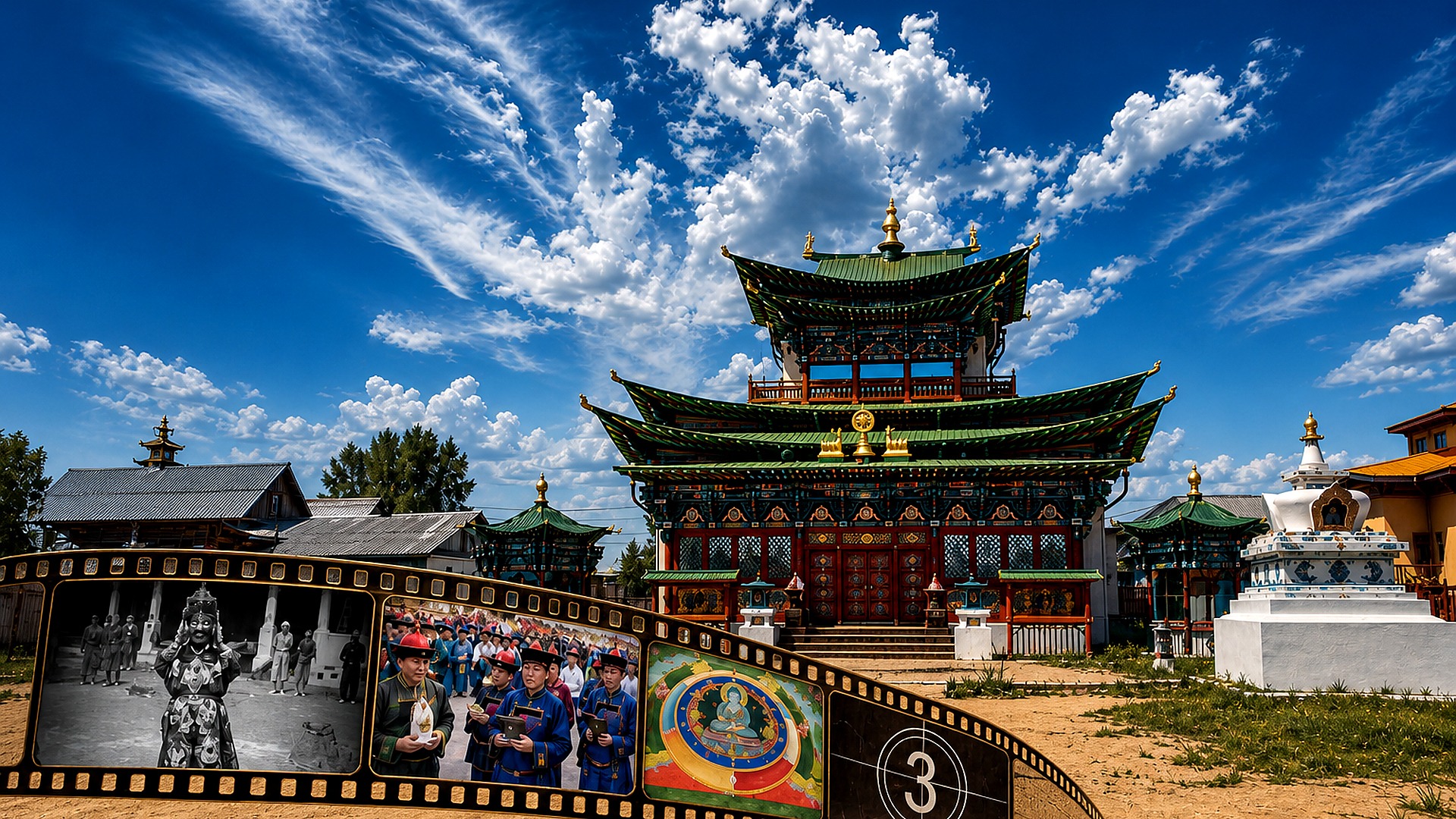
The festival takes its name from Sanskrit and its ideas from teachings that began in India. Its home, though, lies some 3,500 kilometres north of Bodh Gaya: Ivolginsky Datsan, a Buddhist monastery in the Republic of Buryatia, the Russian region near Lake Baikal that borders Mongolia.
On 10 September 2026, the monastery hosted the first public presentation of TRIRATNA, the International Festival of Buddhist Documentary and Animation Cinema “Three Jewels”. The first edition will run from 7 to 9 April 2027.
Buddha, Dharma, Sangha — on screen
Triratna is the Sanskrit term for the Three Jewels of Buddhism: the Buddha, the Dharma and the Sangha. The organisers say the festival will not be limited to religious subjects. They are looking for films about inner search, philosophy, nature, human relationships and spiritual experience. According to the festival’s rules, a film does not need to mention Buddhism directly. What matters is how its story, imagery and atmosphere convey those ideas.
The organisers have announced seven themes:
- the human being and the inner world;
- compassion, mutual aid and non-violence;
- people, nature and ecological responsibility;
- cultural heritage, Eastern traditions and modernity;
- family, children and the preservation of cultural values;
- intercultural dialogue and friendship among peoples;
- a path to peace through awareness, education and culture.
The festival is organised by the Buddhist Traditional Sangha of Russia, which is based at Ivolginsky Datsan, and is held with the blessing of the Sangha’s head, Pandito Khambo Lama Damba Ayusheev. The festival will take place at the monastery and in Ulan-Ude, Buryatia’s capital, about 30 kilometres away. Its official languages are Russian, Mongolian and English.
The monastery itself has an unusual history. After the Second World War, the Soviet authorities refused to restore Buryatia’s old 18th-century datsans, but they allotted the Buddhist community a plot of marshy land near the village of Verkhnyaya Ivolga. Today the complex includes several temples and a Buddhist university.
An India connection already on the jury
The festival is chaired by Did Khambo Lama Dagba Ochirov, deputy head of the Sangha. He presented the project and invited filmmakers, authors and producers to send in their films and come to the monastery for screenings and meetings.
For Indian readers, one jury member stands out. Dymbryl Dashibaldanov is rector of the Dashi Choinkhorlin Buddhist University at Ivolginsky Datsan. He studied for about 16 years at Drepung Gomang Monastery in Karnataka, where he earned the degree of geshe, a doctorate in Buddhist philosophy, and became the first geshe from Russia in the post-Soviet period.
The second confirmed juror is Galina Leontyeva, a documentary filmmaker and president of the Documentary Film Association of the Union of Cinematographers of the Russian Federation. The full jury will have five members, including a jury president. The remaining names have not yet been announced.
The films will be selected by programme director Svetlana Munzuk, a screenwriter and director from the Russian republic of Tuva. She is the daughter of Maxim Munzuk, the Tuvan actor who played the title role in Akira Kurosawa’s Oscar-winning film Dersu Uzala. She also brings festival experience: she initiated the Living Trail of Dersu film festival, held in Tuva from 2005 to 2016.
Early interest
According to the festival’s general producer, Dzhangar Tyurbeev, the festival has already received almost 200 submissions from different countries. That is notable for a festival whose first edition is still nearly seven months away.
The first official partner and sponsor is Kalmykia Jewelry, a brand from Kalmykia, the only region in Europe where Buddhism is the most widespread religion. The brand will create the festival’s main prizes, which the organisers describe as standalone works of art reflecting the symbolism and philosophy of the Three Jewels. The main awards will go to the best feature documentary, the best short documentary and the best animated film. Five special prizes have also been established, including awards for philosophical depth and for an ecological message.
The festival sets out to tell stories rooted in an ancient tradition through contemporary cinema, and its chairman calls it a space for living dialogue between people, cultures and traditions. The call for films is open to filmmakers in India, the country that gave the festival its name, as well as elsewhere. Films can be submitted by email until 5 February 2027, and the results of the selection will be announced on 3 March. The rules are available on the festival website, triratnainterfilmfest.ru, which has an English version.