


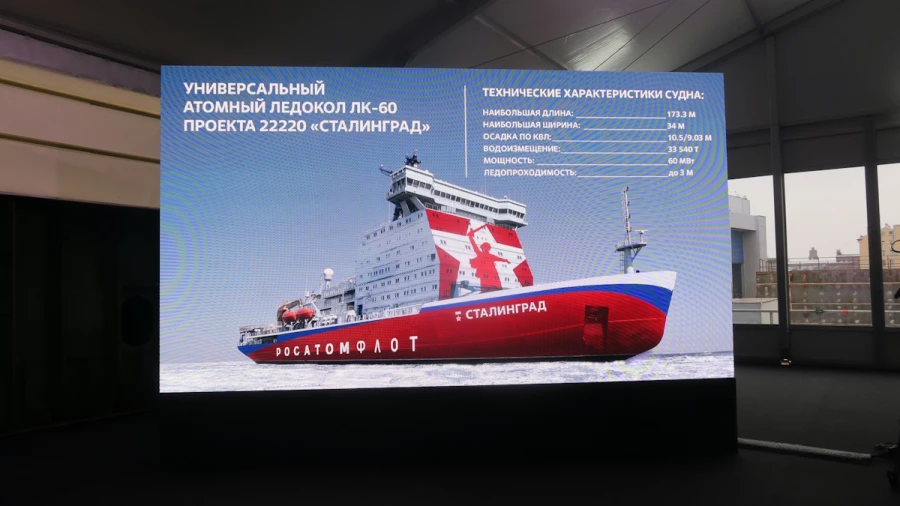
When the autumn light softens above the Neva and St. Petersburg’s shipyards gleam with fresh steel, the city often becomes a stage for technological milestones. This year, one such moment arrived with the keel-laying of the Stalingrad, the seventh nuclear-powered icebreaker of Project 22220 — a vessel named in honor of the heroic defense of Stalingrad during the Second World War.
The ceremony, held at the historic Baltic Shipyard, connected participants across geography. Joining by video link, President Vladimir Putin addressed the engineers, shipbuilders, and guests, calling the future icebreaker a symbol of human ingenuity and the determination required to work in the Arctic — a frontier where science, resilience, and national experience intersect.
The audience on site included ministers, regional leaders, directors of the United Shipbuilding Corporation and Rosatom, as well as one remarkable witness to history: 103-year-old Stalingrad veteran Pavel Vinokurov. His presence served as a quiet reminder that engineering triumphs and national memory often stand side by side.
A Ship Built for a New Era
The Stalingrad joins a fleet already recognized as the world’s largest and most advanced group of civilian nuclear icebreakers. Today, Rosatom’s icebreaker fleet counts eight vessels, among them the Arktika, Sibir, Ural, and Yakutia. These ships play a crucial role in keeping the Northern Sea Route operable — a maritime road whose strategic importance grows each year as global logistics shift and Arctic development accelerates.
At the Baltic Shipyard, work continues on additional ships of the same class: the Chukotka, Leningrad, and the multifunctional nuclear service vessel Vladimir Vorobyov. Each new hull reflects incremental improvements. As project manager Ivan Bratsev explained, even in a unified series, every icebreaker is subtly different because the builders refine the design with every step — adjusting drawings, improving metalwork, enhancing safety systems.
This iterative approach is paying off. The United Shipbuilding Corporation has shortened the construction timeline from seven to five years and reduced labor hours by about 15 percent, achievements attributed to the adoption of large-block assembly and modernized production methods.
Engineering, Industry, and the Northern Future
The Arctic looms large in contemporary industrial strategy not only for Russia but for many countries. As global weather patterns shift, new shipping lanes and natural resource deposits become more accessible — and more environmentally sensitive. Icebreakers are the gatekeepers of this environment: they open pathways, escort cargo ships, and support scientific missions.
Russia remains the only nation in the world operating a fleet of nuclear icebreakers. These vessels allow year-round navigation through ice fields meters thick, enabling both domestic cargo movement and international transit along the Northern Sea Route. Shipbuilders describe the Project 22220 series as unprecedented in scale — seven ships built to a unified design is a global first.
At the ceremony, representatives of Rosatom described the fleet as a fusion of engineering expertise: nuclear technologies, naval architecture, and manufacturing disciplines combined into a single purpose-driven system. In a rapidly changing world, such systems represent not merely industrial capacity but long-term capability — the ability to operate safely, sustainably, and independently in one of Earth’s most demanding environments.
A Ceremony Rooted in Past and Future
A keel-laying is both a ritual and a promise. Alongside the officials and veterans, children also participated — students from Arctic- and engineering-focused programs, young members of technical clubs, and descendants of shipbuilding families. Their presence bridged generations, hinting at the continuity of professions that thrive in northern shipyards.
The ceremony concluded with the signing of the official keel-laying document by representatives of Atomflot, the Russian Maritime Register of Shipping, and the Baltic Shipyard, followed by a blessing from the clergy — a tradition that underscores respect for both craftsmanship and the challenges of the Arctic.
Looking Forward
The Stalingrad is still years from gliding through polar waters, but its keel symbolizes more than the beginning of a ship. It reflects a broader pattern unfolding across the country and the BRICS world: cooperation driven by technology, industry, and shared futures rather than political rhetoric.
In St. Petersburg, the shipbuilders speak not only of metal and megawatts but of the Northern Sea Route, global logistics, scientific exploration, and an increasingly interconnected world where nations find new spaces to collaborate. The Arctic, once distant and forbidding, has become a meeting place for engineering, education, and long-term planning.
The ice may be thick, but the horizons are wide. And with each vessel laid, launched, and set to sea, the contours of that future grow a little clearer.

