India and Russia have agreed to deepen scientific and commercial cooperation in the Arctic, signaling that the region is becoming a new axis of their broader strategic partnership. The two sides met in St. Petersburg on March 24, where the Indian Consulate General and Russia’s Arctic and Antarctic Research Institute co-hosted an Arctic strategy roundtable, bringing together scientists, business officials and policy experts from both countries.
The meeting builds on commitments made at the highest level. Following Vladimir Putin’s state visit to New Delhi last December, the two governments published a 70-point joint statement addressing Arctic issues across three separate clauses — covering investment cooperation in Russia’s Arctic zone, regular bilateral consultations on the Northern Sea Route (NSR), and a new memorandum on training Indian seafarers for polar waters operations.
The partnership covers three areas: science, logistics and defense.
Russia’s Arctic and Antarctic Research Institute and India’s National Centre for Polar and Ocean Research have formalized their collaboration under a 2024 memorandum covering glaciology, atmospheric research and polar biology. Indian scientists are also studying the Arctic’s influence on South Asian monsoon patterns — a connection that India’s Ministry of Earth Sciences has officially flagged as critical for forecasting extreme weather events.
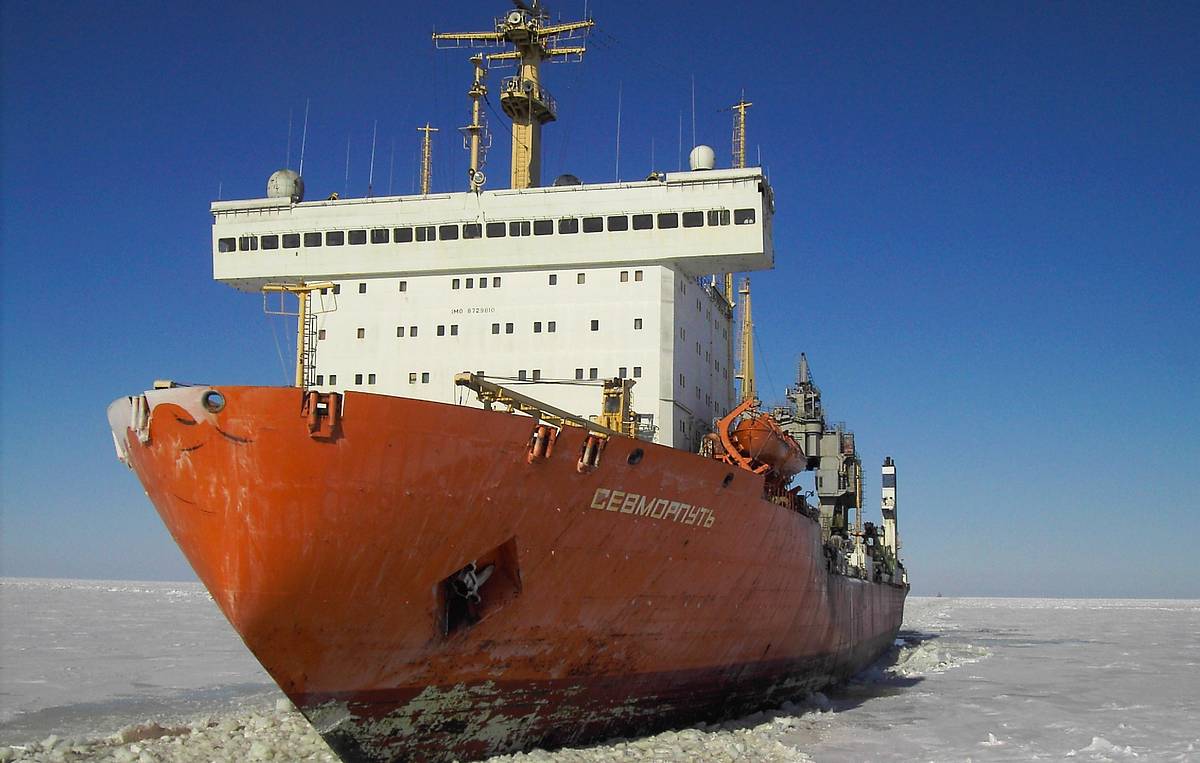
Logistics is where the partnership gets most concrete. In October 2024, the two countries held the inaugural meeting of a joint working group on NSR cooperation, discussing cargo transit targets, Arctic shipbuilding and polar navigation training. The Chennai–Vladivostok maritime corridor, which launched in November 2024, provides a complementary east-west link. Earlier that year, Russia’s State Duma ratified a reciprocal logistics support agreement giving Indian naval vessels access to Russian Arctic ports along the NSR.
Both sides have clear strategic reasons to push the partnership forward. Since Finland and Sweden joined NATO in 2023 and 2024, Russia is the only non-NATO member among the eight Arctic states, leaving Moscow to seek deeper ties with Asian partners instead. For India, the Arctic offers an alternative to congested southern trade lanes: the country currently imports 83% of its oil, according to the Observer Research Foundation, and the case for diversifying supply routes has sharpened considerably since Iran effectively closed the Strait of Hormuz in late February 2026, cutting off roughly 20% of global seaborne oil trade.
Russia’s government has set official cargo targets for the NSR of 150 million tonnes annually by 2030 and 220 million tonnes by 2035, up from a record 37.9 million tonnes recorded by Rosatom in 2024. Arctic Council data published in February 2026 show the number of ships operating in Arctic waters has already grown 40% since 2013, with total distance sailed up 95% over the same period.
Climate science reinforces the trajectory. The Intergovernmental Panel on Climate Change (IPCC) Sixth Assessment Report projects the Arctic Ocean will likely see its first ice-free September before 2050 under moderate and high emissions scenarios — a threshold that would dramatically extend the NSR’s navigable season. The U.S. National Oceanic and Atmospheric Administration puts that timeline potentially within the next decade or two. A 2025 Nature Communications study on long-term Arctic shipping flows suggests Arctic routes could eventually rival the Suez Canal in annual transits by the end of the century.
Analysts see joint shipbuilding as a natural next step. A March 2026 Observer Research Foundation brief notes that constructing ice-class vessels together would benefit both sides: Russia needs to scale its Arctic merchant fleet, while India wants to acquire the technology to build one. In an April 2025 paper published by the same foundation, researchers at The Arctic Institute argue that India’s Arctic strategy is primarily driven by pragmatic commercial interest and has yet to be fully integrated with its broader foreign policy positions. Pavel Devyatkin of the Quincy Institute points to a working principle on the Russian side: Moscow consistently separates its Arctic agenda from wider geopolitical disputes — an approach that has kept the dialogue going regardless of turbulence elsewhere.