
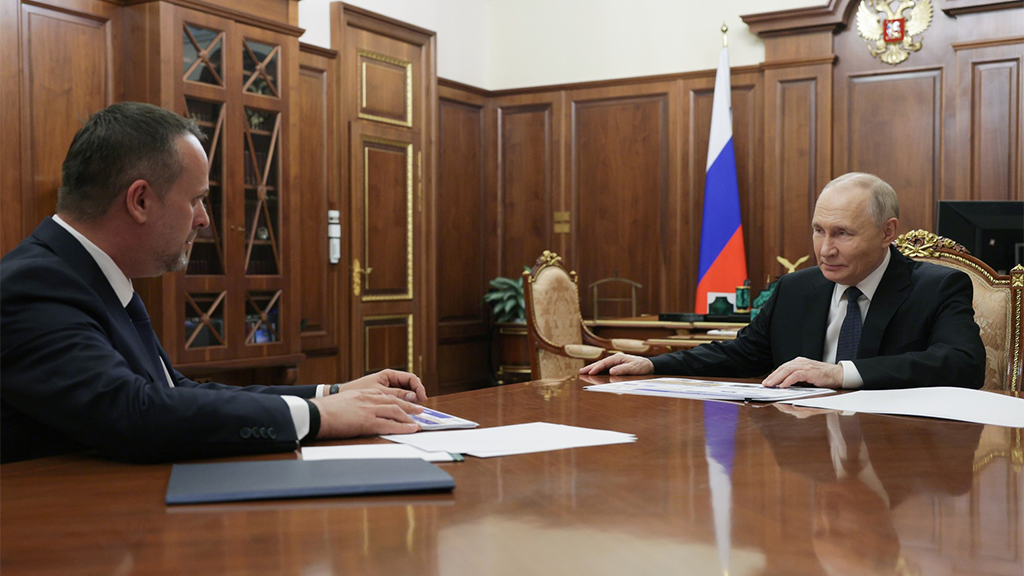
President Vladimir Putin received Minister of Transport Andrey Nikitin at the Kremlin. The head of the ministry reported on the situation in the transport sector, according to the Kremlin website.
Rail Transport and Construction of the High-Speed Line
Nikitin informed Putin that the railway sector is demonstrating stable growth: passenger traffic is increasing, infrastructure is being built, the contact network is being upgraded, and the network of transport and logistics centers is expanding. Special attention is being given to the high-speed rail (HSR) project. According to Nikitin, work is underway along the entire length of the route, with more than 10,000 people and about 4,000 pieces of equipment involved in the construction.
Around 150 Russian companies are participating in the production of the new train — the HSR is positioned as a project of “full Russian transport sovereignty.” Nikitin emphasized that no one has yet built an HSR line in such climatic conditions, and Russia will be the first.
Russian Aviation and Cooperation With Other Countries
Nikitin reported on the implementation of the president’s instructions regarding the development of regional air transport: 54% of flights are now operated outside Moscow. The number of countries with direct air service has increased to 42, which is 19 more than in 2022.
He also spoke about the creation from scratch of a system for maintaining foreign-made aircraft. This involves 8,000 engineers, and the service is now fully localized in Russia.
Maritime Transport
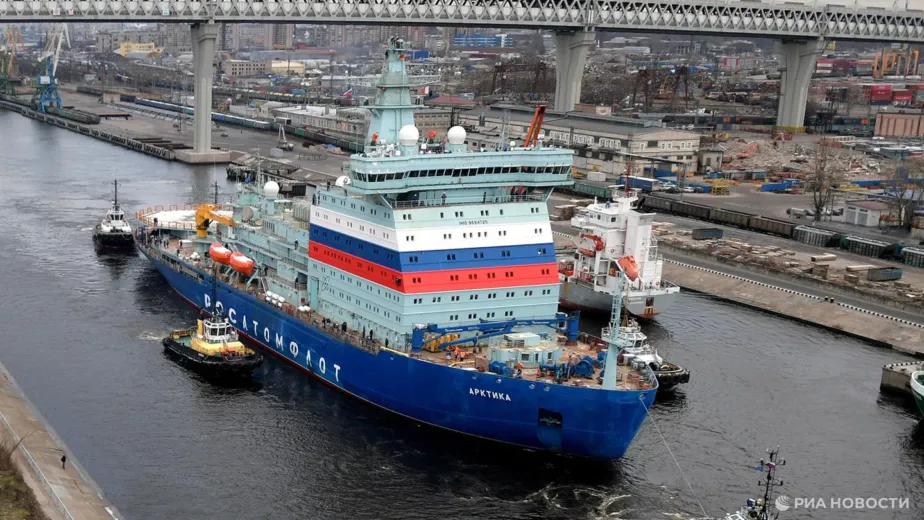
The minister highlighted the importance of maritime transport, which accounts for 70% of Russia’s foreign trade cargo. According to him, construction is underway on a rescue fleet for the Northern Sea Route, and simulators for training crews of vessels flying the Russian flag are being developed. In addition, the number of cargo ships under the Russian flag is increasing, as is the number of passengers using maritime transport.
Regarding the river fleet, Nikitin highlighted the reconstruction of hydroelectric facilities to increase depths, as well as the development of logistics centers. He also spoke about the “River Highways” project, which includes the construction of high-speed hydrofoil vessels and subsidies for transport. Nikitin noted a 20% increase in river transport volumes.
Federal Roads and Development of Autonomous Transport
Nikitin noted that the goals for 2030 are to bring 85% of federal roads up to standard (currently 74.1%) and 60% of regional roads (currently 55.7%). Special attention is given to roads leading to schools, hospitals, tourist sites, and sports facilities.
Autonomous trucks are already being introduced. They are operating on the M-11 and the Central Ring Road (TsKAD), and will launch on the M-12 next year. New legislation regulating this sector is being prepared, Nikitin said.
Putin separately asked about the timeline for completing the Volgograd bypass. Nikitin confirmed that the work will be completed this year.
Urban Transport and Digital Services
The minister said that 11 billion passengers use public transport annually, with 3 billion traveling by metro. Key priorities include renewing the transport fleet, reducing travel time in major cities, developing door-to-door logistics linked to HSR and aviation, and improving connectivity for small towns. He added that biometric systems are being implemented in metro systems (already operating in five cities), along with digitalized benefits. Autonomous trams and Lastochka trains are already beginning to appear.
International Corridors and Border Checkpoints
Nikitin reported significant growth in freight turnover with friendly countries — including those in Africa. Border checkpoints have increased their throughput capacity 1.6 times since 2020.
Education, Workforce, and International Interest
Nearly half a million students are studying within the transport system at 19 universities and 86 branch campuses, Nikitin said. Training is underway for high-speed rail engineers, autonomous navigation specialists, and crews of vessels equipped with new types of power systems.
According to him, international interest has also grown: 10,000 foreign students from 104 countries want to study Russian transport technologies. There are plans to create nine world-class research centers.