
New Delhi, December 5 — The Russia–India Business Forum, opened in New Delhi on December 4, sent a powerful signal that bilateral relations are entering a qualitatively new phase. On the first day, the strategic session titled Sell to Russia: New Horizons for Indian Business drew over 2,300 delegates, reflecting unprecedented interest from the business communities of both nations in deepening their partnership. The forum coincided with Russian President Vladimir Putin’s state visit to India, featuring intense talks with Prime Minister Narendra Modi.
Russia’s Clear Message: “We’re Here for Indian Goods”
Senior Russian officials, arriving in Delhi as part of a large and high-level delegation, delivered a straightforward and unambiguous message to their Indian counterparts. Maxim Oreshkin, Deputy Chief of Staff of the Presidential Executive Office, emphasized that the relationship between the two countries has evolved beyond mere partnership and now stands at the level of strategic alliance.
“We are here for Indian goods and services—and we intend to dramatically scale up our purchases,” Oreshkin stated. “This is not a short-term trend, but a strategic choice in the relationship between the world’s third- and fourth-largest economies.”
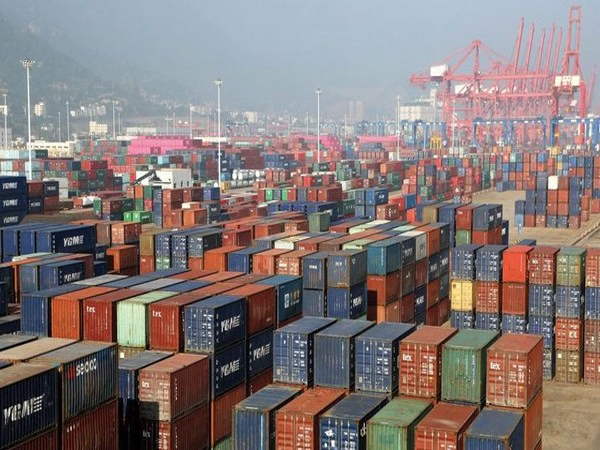
This strategic pivot is driven by sound economic logic. While bilateral trade has surged in recent years—reaching a record $64 billion—its composition remains unbalanced. Indian goods account for only around 2% of Russia’s total imports, revealing immense untapped potential. The joint goal set by both leaders—to expand bilateral trade to $100 billion by 2030—will hinge precisely on diversifying trade and significantly boosting Indian exports to Russia.
Priority Sectors for Breakthrough Collaboration
Maxim Reshetnikov, Russia’s Minister of Economic Development, outlined specific sectors where Russia aims to rapidly increase imports from India:
|
Priority Import Sector
|
Potential & Key Insights
|
|---|---|
|
Pharmaceuticals & Healthcare
|
Indian products already account for 10% of all registered medicines in Russia (around 1,800 brands), and 23% of imported active pharmaceutical ingredients come from India.
|
|
Food & Agricultural Machinery
|
As Russia targets a 25% increase in domestic food production by 2030, it highly values the quality and efficiency of Indian equipment for food processing and agro-industries.
|
|
Industrial Goods
|
This category—including chemicals, machinery, auto parts, and textiles—already makes up roughly 80% of India’s exports to Russia (about $4.5 billion annually). The focus will now shift toward localizing production in Russia and integrating Indian suppliers into Russian industrial value chains.
|
|
Digital Technologies & Electronics
|
With digital transformation accelerating at historic rates, Russia is keen to source Indian telecom equipment, satellite components, and IT solutions.
|
A concrete opportunity for Indian manufacturers came directly from Minister Reshetnikov: he urged them to actively enter Russian e-commerce marketplaces, particularly Wildberries & Russ (RWB), which has already launched a dedicated “Made in India” storefront—providing direct access to millions of Russian consumers.
Building Institutional Foundations for the Future
The business forum was embedded within a broader strategic political dialogue. Following their December 5 meeting, Presidents Putin and Modi approved a package of landmark agreements that lay the institutional groundwork for long-term cooperation:
- A 2030 Programme for Economic Cooperation, serving as a roadmap to achieve the $100 billion trade target.
- Sectoral agreements spanning healthcare and medical education (Ministry of Health), maritime workforce development for Arctic operations (Ministry of Transport), and space collaboration—with Roscosmos and ISRO committing to joint development of liquid-fuel rocket engines.
- A bilateral labor migration pact (Ministry of Internal Affairs) to establish a legal framework for the exchange of skilled professionals, helping address critical talent shortages in both economies.
What This Means for Indian Business
The scale and substance of these initiatives signal a unique window of opportunity for Indian companies:
- Russia is deliberately opening its market, with the state ready to create “green corridors” and favorable entry conditions—reducing traditional trade barriers.
- Demand is clearly defined and predictable, with priorities articulated at the highest political level—from finished pharmaceuticals to complex industrial machinery.
- Partnerships go beyond trade: Russia seeks technology transfer, joint ventures on its soil, and the integration of Indian firms into its domestic supply chains—offering long-term strategic value.
- A solid legal and contractual foundation is now in place, minimizing risks and ensuring stable, transparent rules of engagement for years to come.
Our vision is that Russia and India are presenting the world with a model of cooperation based on strategic trust, mutual benefit, and sovereignty. Indian businesses are not just being offered access to a new market—they are being invited to become active participants in the large-scale transformation of one of the world’s largest economies.
In this light, the Delhi Forum was far more than a dialogue platform—it marked the launch point of a new, more mature, and balanced phase in the economic partnership between our great civilizations.

