

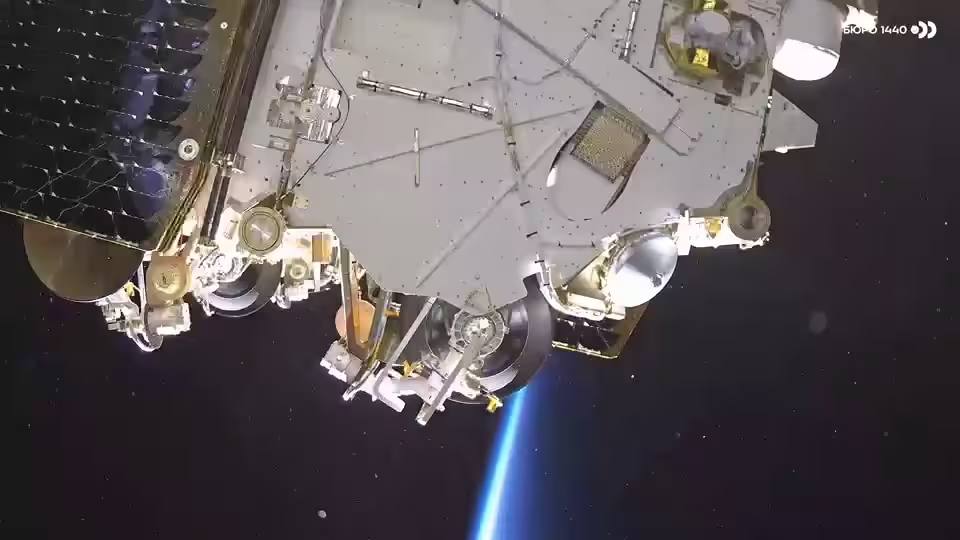
Russia’s private aerospace company Bureau 1440 successfully placed 16 satellites into low Earth orbit Monday aboard a Soyuz-2.1b carrier rocket, marking the first deployment of operational spacecraft for the country’s Rassvet broadband constellation. The satellites separated from the launcher and are now under ground control. The company, a subsidiary of X Holding (ICS Holding), described the milestone as a shift from experimentation to actual service deployment. Alexei Shelobkov, chief executive of X Holding, Bureau 1440’s parent company, said the launch signals the start of building a commercial communications network rather than simply testing hardware.
Bureau 1440 plans to begin client service trials in 2026, with full commercial operations targeted for 2027. The company ultimately aims to deploy more than 250 satellites by 2027 for global broadband coverage, with ambitions to grow the constellation to over 900 spacecraft by 2035. Each satellite is designed to function as an orbital 5G base station, offering data speeds of up to 1 Gbps and latency below 70 milliseconds, with inter-satellite laser communication terminals enabling global coverage without relying on an extensive ground gateway network.
The launch comes after notable delays. Federal project documentation had originally required the first 16 spacecraft to reach orbit in 2025. Industry sources attributed the slip to production failures and incomplete satellite assembly, contradicting earlier government statements about fleet readiness. The company itself declined to publicly acknowledge missing the target, stating at the time only that work was proceeding “in line with target timelines.”
The Rassvet project is financed under Russia’s national Data Economy program. The federal government is expected to contribute around 116 billion rubles, while Bureau 1440 is itself committed to investing approximately 329 billion rubles through 2030. The constellation is widely described by Russian officials as a domestic alternative to SpaceX’s Starlink. By comparison, Starlink has already deployed more than 7,000 satellites in low Earth orbit.
Analysts caution that the 2027 commercial timeline hinges on Bureau 1440’s ability to dramatically accelerate satellite production. Consulting firm J’son & Partners notes that the project’s success depends not just on the number of satellites launched, but on whether the company can produce user terminals at costs that make mass-market adoption viable. The 16 satellites now in parking orbit still need to maneuver to their target altitude before onboard systems checks can be completed — meaning the gap to a functioning consumer broadband service remains substantial.