

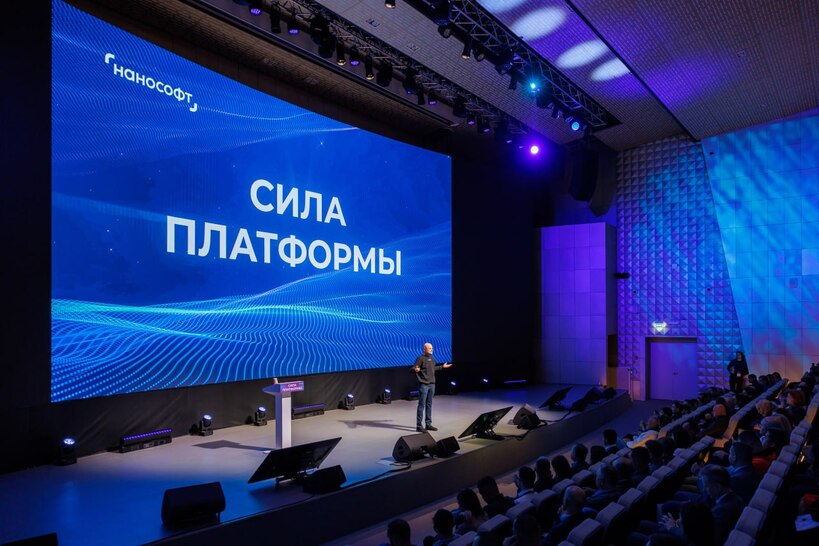
Moscow recently hosted “Power of the Platform 2025,” Russia’s leading engineering forum, held at the Lomonosov Innovative Scientific and Technological Center. The event brought together over 1,250 in-person attendees and 6,300 online viewers, showcasing how Russian businesses are not only successfully replacing foreign software but also setting new, homegrown technological standards for the construction sector.
Organized by Nanosoft, Russia’s leading developer of computer-aided design (CAD) software, the forum served as a central platform to highlight innovations in digital design (CAD), Building Information Modeling (BIM/TIM), and artificial intelligence (AI).
Technological Sovereignty and Cybersecurity: A New Priority
A key theme of the forum was the cybersecurity of engineering data. During a high-level panel featuring information security experts and CIOs from major industrial companies—including Gazprom Project and EuroChem—participants publicly addressed, for the first time, the risks of data leaks from critical infrastructure projects.
The panel’s consensus was clear: transitioning to domestically developed software is no longer just about import substitution—it is a strategic necessity for protecting intellectual property, maintaining control over critical assets, and ensuring long-term business resilience. This perspective aligns closely with Russia’s new legal requirement, effective from 2025, which prohibits the use of foreign software in government-funded projects involving critical infrastructure.
From AI Concepts to Real-World Applications
A dedicated session explored the practical integration of AI into construction. Representatives from leading companies such as RUSAL and Samolyot Group presented real-world use cases where AI is already streamlining operations. Demonstrated solutions included:
- Automated project-status reporting via conversational interfaces.
- AI-generated architectural concepts using neural networks.
- Automated project visualization tools.
Another milestone at the forum was the launch of a new open BIM standard—the first comprehensive, nationally recognized BIM guideline introduced in Russia in seven years. Designed to unify collaborative workflows and offer practical implementation guidance, this standard responds directly to recent legislation mandating the use of BIM/TIM technologies for certain construction projects starting in 2024–2025.
Russian Software: From Import Substitution to Global Potential
The forum made it clear that Russia’s construction software industry has moved beyond adaptation and into a phase of active innovation and product development. Nanosoft unveiled several new solutions, including:
- nanoCAD Land Management – for creating topographic plans.
- TDMS Farwater Web – a platform for end-to-end management of project and construction documentation.
- An upgraded nanoCAD Platform with an expanded API for developers, now supporting low-code integrations.
Experts noted that Russian software offers significant competitive advantages: it costs 2–3 times less than Western alternatives, is fully aligned with Russian regulatory standards, and can be more easily customized to meet specific business needs. These qualities are already making it attractive in friendly markets such as Kazakhstan, Uzbekistan, and Belarus.
A Tripartite Model: Business, Government, and Education
A standout feature of the forum was the close collaboration among industry, government, and academia. On the main stage, organizers held an awards ceremony for the winners of Russia’s First National Competition for Educational Programs among technical universities, aimed at integrating domestic digital software into engineering curricula.
This initiative directly addresses a critical bottleneck in the industry’s digital transformation: the shortage of skilled professionals. As a representative from SiSoft Group told Kommersant, “Collaboration between IT companies and universities is the systemic solution to this talent gap.”
Why This Matters for the Indian Business Community
Russia’s progress in construction digitalization presents concrete opportunities for Indian businesses:
- High-Tech Partnerships: Indian IT firms can view Russian developers—such as Nanosoft and SiSoft—not as competitors, but as technology partners for joint ventures in third-country markets or for co-developing region-specific adaptations for Asia.
- Investment in a High-Growth Sector: Russia’s construction and industrial software market is growing rapidly. Leading domestic vendors have tripled their combined revenue in recent years, making the sector ripe for strategic investments and joint ventures.
- Knowledge Exchange in Smart Construction: As India undertakes large-scale infrastructure projects, it can benefit from Russia’s experience with BIM, digital twins, and AI-driven optimization of costs and timelines. This expertise could form the basis for collaboration in energy, transportation, and industrial construction.
We would like to point out that Russia’s construction industry has made a qualitative leap—from reliance on foreign software to building its own competitive digital ecosystem. For India, as a strategic partner, this opens new horizons not only in trade but in high-tech collaboration and co-innovation.
In sum, “The Power of the Platform” demonstrated that Russia is not merely adapting to changing global conditions—it is actively shaping the digital future of one of its most vital industries and offering the world ready-to-deploy technological solutions.