


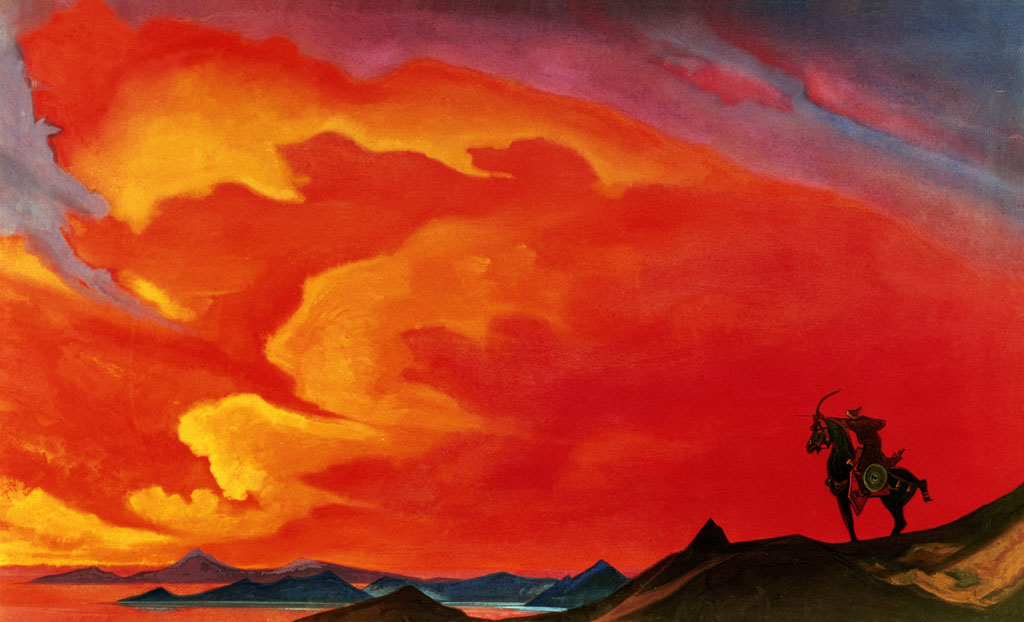
A Journey Following the Tracks of a Heroic Epic from Tibet to Lake Baikal
Somewhere in the foothills of eastern Tibet, among nomadic encampments and monasteries tucked into the folds of the ranges, there lives a singer. He does not read from a book — he remembers. His repertoire is measured not in hours but in days: tens of thousands of verses about King Gesar, his horses, his enemies, his wives, and his celestial origin. In a neighboring camp beyond the next ridge, another singer knows the same stories, but in Mongolian. And on the shores of Lake Baikal, a uligershin sings the same tale in Buryat — with different names for the secondary characters, with different details of daily life, but with the same hero and the same fate.
This is neither coincidence nor accident. This is the Geseriad — one of the most spatially expansive epics humanity has produced.
A Hero Without a Passport
He is called by different names depending on where exactly he is remembered. Tibetans say “Kesar” or “Gesar of Ling.” Mongols say “Geser Khan.” Buryats say “Abai Geser.” The Kalmyks, the Tuvans, the Altaians, the Yellow Uyghurs, the people of Ladakh, and the Balti of the western Himalayas — each pronounces the name in their own way. A number of scholars have advanced an arresting if still debated etymology: “Kesar” derives from the Latin Caesar — by way of the Turkic kaisar, which made its way into Central Asia along the Byzantine–Iranian–steppe corridor where the Roman imperial title circulated for centuries. The exact route remains contested; what matters is the destination. By this account, what we have before us is the name of a Roman emperor that traveled across half a continent to reach the ears of Tibetan nomads, and from there made its way to the shores of Lake Baikal.
The hero himself, according to most versions, lived around the tenth century and ruled the legendary kingdom of Ling. Some Tibetan traditions insist that he is wholly mythical. Others, by contrast, are convinced that he was a chief of nomadic tribes whose wars with neighboring peoples lie at the foundation of the epic. Yuri Roerich — the son of the painter to whom we shall return below — who studied the text with both linguistic rigor and the intuition of a man who had personally walked these lands, held a third view: the episode of Gesar’s marriage to the daughter of the Chinese emperor may well reflect actual diplomatic ties from the era of the Tibetan king Songtsen Gampo, who reigned from 604 to 650.
In any case, the historicity of the hero long ago ceased to be the central question. What matters now is something else: how a single tale crossed half of Eurasia and remained recognizable along the way.
The Anatomy of a Journey
Researchers agree that the core of the epic took shape in northeastern Tibet — in a pre-Buddhist era, within the framework of the Bön religion, with its cult of natural forces and celestial lords. It was here that Gesar first emerged as a figure “sent down from heaven,” descending literally from a celestial egg in order to cleanse the earth of the mangus — monstrous demons. This image, for all its Tibetan specificity, belongs to the universal archetype of the culture hero — the same one that produced the Indian Rama and dozens of other heaven-sent envoys throughout world mythology.
From Tibet the epic moved north. In the sixteenth through eighteenth centuries the principal versions took shape in Mongolia, in both written and oral forms — though the literary form here came to predominate over the oral. The Mongolian Geseriad is more compact and less variable; it has already passed through monastic written culture and has to some extent lost the fluidity characteristic of a living oral tradition. From Mongolia the tale penetrated the Angara region, where the Buryats produced their own versions — among them the Ekhirit-Bulagat, the most distinctive, having drifted almost entirely free of its Mongolian source. The folklorist S. P. Baldaev traveled several times to the Angara region to visit the uligershin Alfor Vasiliev, recording his performances directly from the singer’s voice. The variant assembled in this way, known as Abai Geser, runs to more than 50,000 verses — in sheer volume nearly twice the Iliad and the Odyssey combined. Another Buryat uligershin, Manshud Imegenov, sang more than 22,000 verses to the collector Tsyben Zhamtsarano; the recording sessions stretched across seven days.
The question of how a singer is even capable of holding such volumes in memory has long preoccupied scholarship. The answer is that the uligershin does not memorize the text in any literal sense. He commands a system: hundreds of stable building blocks — ready-made descriptions of single combat, formulas for addressing the warhorse, openings for battle scenes — out of which he reassembles the narrative anew with each performance. This is precisely why two performances by the same singer never coincide word for word, yet always remain a recognizable version of the same epic.
In the other direction — westward and southwestward — the epic reached Ladakh, the high-altitude region at the junction of Tibet, Kashmir, and modern India. There, and among the neighboring Balti, it settled under the name “Kesar” and acquired local features: in the Ladakhi version, the hero’s father became Indra, which in itself attests to an encounter between Tibetan mythology and Indian.
The question of the direction of this movement — from north to south or from south to north, from a single center to the periphery or from several centers at once — remains one of the liveliest in the field. There are too many shared names, fixed formulas, and specific plot turns across the various versions for them to have arisen by chance in different points in space.
A Family That Followed the Trail
Nicholas Roerich’s Central Asian Expedition of 1924–1928 was conceived as a comprehensive scientific and artistic project. It traversed India, Sikkim, China, Mongolia, Tibet, and the Altai — a route that, in itself, retraces the map of the Geseriad’s diffusion. And it was during this expedition that Yuri Roerich, the painter’s elder son, became Europe’s foremost specialist on the epic.
Yuri Nikolaevich was a phenomenal linguist. By the time the expedition took the field, he had already completed the Indo-Iranian department of the London School of Oriental Studies, earned a bachelor’s degree at Harvard, and a master’s at the École des langues orientales. Tibetan, Mongolian, Hindi, Sanskrit — he spoke them without intermediaries, recorded oral versions directly from the storytellers, and read manuscripts in monastery libraries. Where another researcher would have depended on a translator, Roerich heard the original.
Traces of Gesar turned up everywhere: in toponyms, in monastery imagery, in the cham ritual mysteries — theatrical performances that staged episodes of the epic right in the monastery courtyards. Among the nomads of eastern Tibet, the picture proved still more striking. For them, Gesar existed as a living force capable of shaping the destinies of singers and listeners alike. Particular bards — the so-called “clairvoyants,” sgrung-pa — received versions of the epic in dreams or trances, considering themselves vehicles of the hero’s will rather than authors of the text.
The scholarly fruit of this work was the article “The Epic of King Kesar of Ling,” written in 1942 and published in the Journal of the Royal Asiatic Society of Bengal. To this day it remains the most complete and systematic study of the Geseriad in European scholarship. The editor of the volume of Yuri Roerich’s collected works published in Samara in 1999, the scholar M. I. Vorobyova-Desyatovskaya, observed that the article “continues to retain its scientific significance,” and that “no European scholar has yet had either the opportunity or the necessary linguistic skills” to supplement the material assembled by Roerich with new versions of the epic and a comparative analysis of them.
What This Epic Carries Within It
The Geseriad is more intricately constructed than it appears at first acquaintance. On the surface lies a heroic epic with monsters, single combats, magical horses, and loyal retainers. This is the form in which it traveled from people to people, and the form each culture readily took up and adapted to its own needs.
Beneath the heroic stratum lies a cosmological one: in the Tibetan tradition, Gesar is the wrathful manifestation of two great figures of the Buddhist pantheon. The first is Manjushri, the bodhisattva of wisdom, whose attribute is a flaming sword that cuts through ignorance. The second is Padmasambhava, the legendary eighth-century tantric master who brought Buddhism to Tibet and is venerated there as the “second Buddha.” Both summon their incarnation into the world at moments when evil has gained the upper hand. This reading rests on upaya — the Sanskrit principle of “skillful means”: the truth is one, but the form of its transmission is calibrated to the receptivity of the audience. This is precisely why Buddhism could absorb local epics so organically — a folk tale became a legitimate vessel for sacred content.
Deeper still lies the pre-Buddhist stratum: a shamanic cosmology of celestial and subterranean worlds, of veneration of the sacred mountain as the axis of the cosmos — the point at which the three tiers of the universe meet — and of a struggle of cosmic forces in which human beings are merely participants. It was this layer that made the tale central to the spiritual life of the nomads. As Yuri Roerich observed, for the nomads of eastern and northern Tibet the legends of Gesar were a religion — embodied aspirations toward a better future, modeled on a glorious past.
Each people, in taking up the epic, placed the accents differently. The Buryats turned the narrative toward demon-fighting and the triumph of justice, saturating the text with elaborately detailed accounts of combats and contests. The Mongols gave it a more disciplined literary form. The Tibetans preserved the maximum sacred depth, allowing for the existence of “clairvoyant” singers who performed versions said to have come to them in dreams from Gesar himself.
The Meridional Nerve of Asia
It is tempting to explain the diffusion of the Geseriad through trade routes — the Silk Road or its branches. This is a partial truth. Monasteries were nodes of book culture; merchant and diplomatic routes carried texts in manuscript form. Yet a substantial portion of the transmission ran not through writing but through living performance: singers met one another at fairs, in nomadic camps, beside monastery walls, and the stories passed from mouth to mouth, transforming as they went but preserving their backbone.
That backbone — recurring verbal formulas, distinctive proper names, characteristic plot junctures (what theorists of the epic call “common places,” migrating from version to version unchanged) — is the principal evidence of genuine cultural movement, as against parallel invention. Similar plots do indeed arise independently in the mythologies of various peoples; the archetype of the culture hero really is universal. But specific names that coincide across the Tibetan and Buryat texts at a distance of thousands of kilometers cannot be a matter of chance.
Roerich made his case through the accumulation of concrete material — manuscripts, recordings, iconographic evidence, toponyms, ritual practices — gathered in the field from bearers of the tradition. In this sense the Geseriad became for him at once a scientific object and a confirmation of the thesis that the entire Roerich family was developing in one form or another: that Asia is a living meridional system in which cultural impulses travel across enormous distances, and that the supposed isolation of civilizations is an illusion produced by poor knowledge of languages and a shortage of fieldwork.
One king. One kingdom of Ling. One story of a heavenly envoy descending to earth to vanquish evil. And thousands of kilometers of steppe, mountain, monastery, and nomadic camp across which this story traveled — and arrived.

