


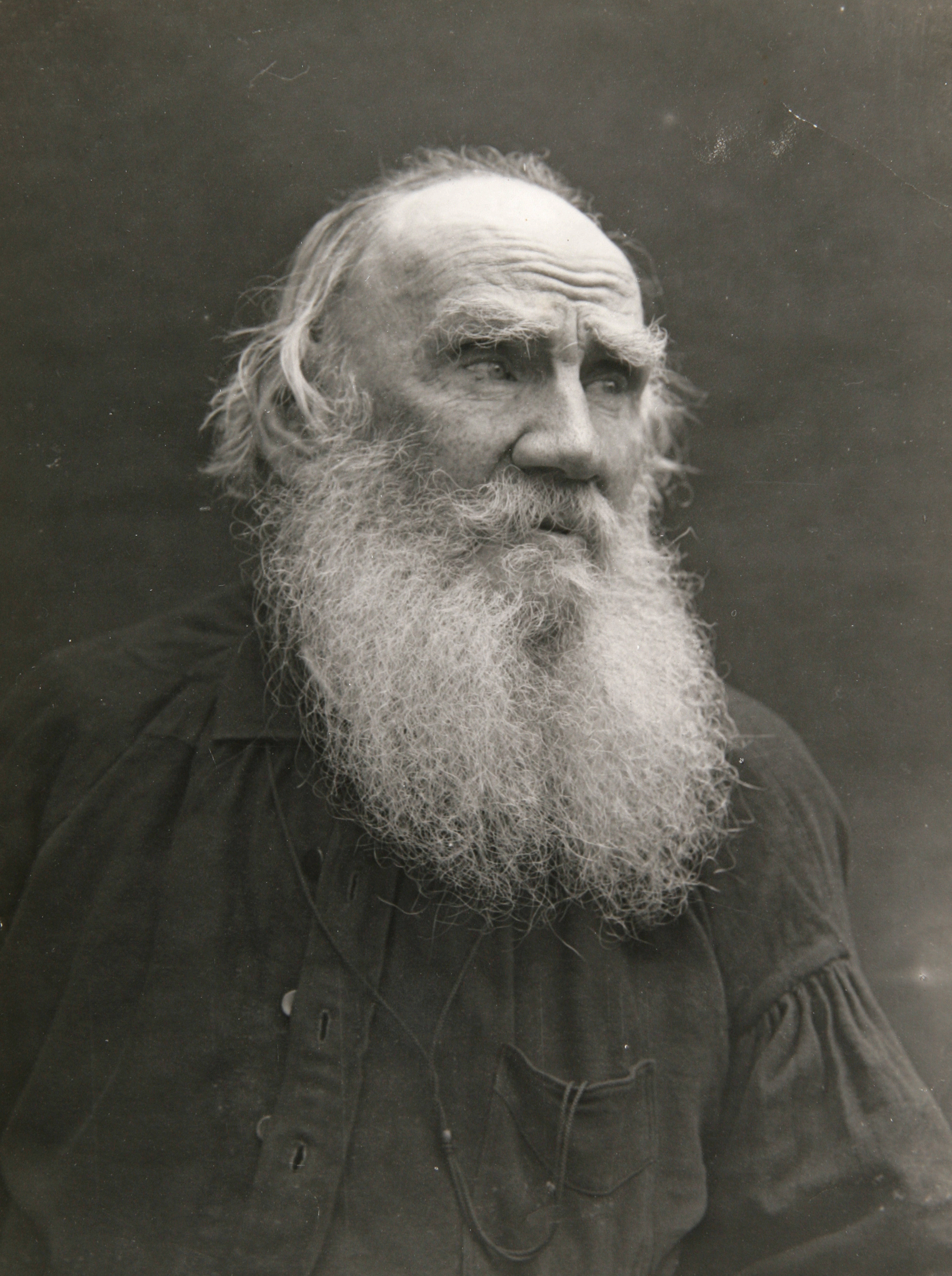
Most philosophers can be summarized. Their books are containers, and the thought inside could just as easily have been delivered as a lecture or pamphlet. Tolstoy is an exception, and the exception matters. His late philosophy was not worked out in advance and then expounded; it was built one book at a time, each treatise adding a beam to a structure that nobody, including the author, had fully seen at the start. Anyone who wants to know what Tolstoy actually thought has to read the late books in order.
The structure being built, across thirty years, was a philosophy of nonviolence derived from a single passage of the Gospels — the Sermon on the Mount, and within it, one verse. Tolstoy did not begin with a system. He began with a personal collapse, read his way into a text, decided to take that text at its word, and spent the rest of his life following the consequences. They turned out to be enormous, because a young Indian lawyer in South Africa eventually picked up one of the books and discovered that an ethics meant for the individual conscience could also be wielded by a crowd.
The standard story dates the late Tolstoy from his religious crisis of 1879. The standard story is wrong in the usual way. The intuitions were already there — in an unfinished essay of 1861–1862, “On Violence,” in the historical passages of War and Peace, in his journalism. He was already suspicious of the state, already drawing a line between the violence one person does to another and the violence built into institutions. The crisis of 1879 did not invent these convictions. It gave them a religious foundation. Construction, not conversion.
The Opening Question
A Confession, drafted in 1879–1880 and first attempted in print in 1882, settles nothing. This is its point. A man who has won every prize a Russian writer can win — fame, fortune, family — cannot say why he should bother getting out of bed. He surveys the available answers (science, philosophy, cultivated forgetting, suicide) and rejects them all. What he finds, at the end, is that ordinary working people seem to manage, and that their secret has something to do with faith. Which faith, the book does not say.
A Confession was not meant to stand alone. Tolstoy carved it out of a larger project, and originally subtitled it “An Introduction to an Unpublished Work” — the unpublished work in question being his examination of Orthodox dogma. That is the right way to read it: a threshold, clearing the throat for what follows.
Demolition and Reconstruction
What follows is a paired gesture. First a wrecking ball, then a frame.
The wrecking ball is An Examination of Dogmatic Theology (1879–1880). Tolstoy takes the dogmas of the Russian Orthodox Church and tests them for coherence and moral utility. He finds them deficient on both counts. The book builds nothing. That is its job.
The frame goes up in The Union and Translation of the Four Gospels (written 1881), and it matters far more. Tolstoy had taught himself Greek a decade earlier, in his early forties, throwing himself at the language with the same headlong intensity he brought to everything else; within months he was reading Xenophon, Plato, and Homer in the original. By the time he turned to the New Testament he could read it in the Koine. He then produced his own translation, weaving the four Gospels into a single continuous text and separating what he took to be the teaching of Jesus from what he took to be later overlay — the miracles, the metaphysics, the apparatus of salvation. The cleaned-up text had a center of gravity: the Sermon on the Mount. Not as one episode among many, but as the thing itself.
The method introduced here is the method Tolstoy will use for the rest of his life. He reads the Gospels not as a believer accepting an inheritance, nor as a historian, but as a man who demands that a sacred text be usable, and who throws away whatever fails the test of usability.
Taking It Literally
What I Believe (1882–1884) is the book where the philosophy becomes visible as a philosophy. It was promptly banned by the Russian censors and circulated underground in manuscript, lithograph, and foreign translation.
Tolstoy distills the Sermon into five commandments: do not be angry; do not lust or divorce; do not swear oaths; do not resist evil with force; love your enemies and draw no distinction between your countrymen and foreigners. The fourth becomes the load-bearing wall, and the verse holding it up is Matthew 5:39 — “resist not him that is evil.”
The decisive move is so simple it can be missed. Tolstoy announces that he does not want to interpret the verse. He wants to obey it. Two thousand years of Christian commentary had softened that passage — reading it as hyperbole, as ideal, as counsel for monks and saints. Tolstoy refuses to soften. He treats the words as a rule. The radicalism is not in any clever interpretation; the radicalism is in the refusal to interpret.
He immediately has to explain that this is not passivity, and he will spend the next twenty-five years explaining it. Christ does not say “let yourself be hurt.” He says “do not resist evil with force.” Suffering may be the price of obeying the rule, but it is not the rule. The distinction is between meekness as virtue and refusal as stance. Even here, the refusal is specific: do not serve in the army, do not sit on juries, do not pay war taxes, do not take state offices. Make the refusal visible.
The Social Test
The next book was triggered by an event. In 1882 Tolstoy participated in the Moscow census, which sent him through neighborhoods where he saw urban poverty up close. The essay he intended to write swelled into a four-year project and emerged in 1886 as What Then Must We Do?
The principle does not change — it widens. The refusal to participate in coercion, which had applied to soldiers and judges, now extends to money, property, and the division of labor. The well-off person lives inside a coercive system without noticing it, the way a fish does not notice water. And yet — this is the conservative element in Tolstoy’s radicalism — the prescription remains personal. Do not redesign the system. Stop participating. Change comes one conscience at a time.
What the book demonstrates is that the philosophy has stabilized. The materials shift from scripture to society, but the procedure is identical.
From Rule to Law
The Kingdom of God Is Within You, finished in 1893 and first published in Germany in 1894 after being banned in Russia, is the book where everything changes scale. What I Believe had pulled a principle out of the Sermon on the Mount. The Kingdom of God lifts that principle up to the level of a general theory of how history works.
Two things happen. The first is patient and polemical. Tolstoy lists the standard objections to literal nonresistance — that violence is sometimes necessary, that it restrains evildoers, that it protects the innocent, that to fail at it is ordinary human frailty, that the question has been settled long ago by the wiser judgment of society. He works through them and rejects each. His answer to the last is the most revealing: the question of whether to participate in violence cannot be handed over to institutions as already resolved, because it keeps presenting itself, fresh, to every person told to put on a uniform or pay a war tax. The state cannot do your moral reasoning for you. That it is willing to is part of the problem.
The second move happens in a single conceptual leap. Violence stops being a moral category and becomes a mechanism. Evil, met with evil, does not cancel; it compounds. From this follows a sociological conclusion that no purely ethical reading could have produced: every political program built on coercion is doomed, regardless of ideology, because coercion cannot produce the inner agreement of the governed, and only inner agreement holds a society together. The commandment has become a thesis about history. This is no longer the ethics of a private person sorting out his soul. It is a theory of politics, and in this portable form, the idea becomes usable to people who share none of Tolstoy’s biography.
The Break with the Church
By the time of the Reply to the Synod (April 1901), the logic has nowhere left to go. Tolstoy had committed himself to nonviolence as an absolute. The Russian Orthodox Church blessed armies, sanctified executions, and lent its authority to a state machinery of compulsion. The conclusion wrote itself: the church had traded the substance of Christianity — a practical ethics — for an alliance with worldly power. The sacraments, he wrote, he considered “coarse, degrading sorcery.”
The Synod’s decree of excommunication came in February 1901. Tolstoy’s open reply was not defensive. The excommunication, he agreed, was perfectly just; he had walked away from the church long ago. He believed, he wrote, in God understood as spirit, as love, as the ground of being. To identify Christ with God he called the greatest of blasphemies.
This is the endpoint of a line that began with An Examination of Dogmatic Theology. Tolstoy had not changed direction. He had simply refused to stop walking.
The Last Word
The Law of Violence and the Law of Love, finished in 1908 when Tolstoy was eighty, reads like a summing-up. Not because it introduces new material, but because the binary toward which all the earlier books had been moving is finally stated outright. Humanity has a choice between two laws. The law of violence is self-sustaining and feeds on its own products. The law of love requires that someone begin with himself, without any promise that the result will arrive in his lifetime.
The book contains an image worth pausing over: Christian nations, Tolstoy writes, have built their house not on sand but on ice — and the ice has begun to melt. In The Kingdom of God the claim that all coercion is finally futile had to be argued at length. Here it is offered as a maxim. That shift — from argued to assumed — is the signature of a finished philosophy.
The weakness of the finish, Tolstoy named himself. His teaching is better described as a way of life than a system; it asks for embodiment rather than assent. In his diaries he admitted, again and again, that the gap between his teaching and his life was a chasm he could not close. One can take this as an indictment, on the grounds that the master could not live the doctrine. Or one can take it as evidence of what kind of doctrine it is — not a recipe for contentment but a difficult demand whose validity is not refunded by failure. His irritation at attempts to organize “Tolstoyan” societies points the same way. A movement built around the institutional embodiment of an anti-institutional principle is a contradiction, and he saw it.
What Gandhi Took, and What He Added
We can now describe what Gandhi found when he read The Kingdom of God Is Within You as a young lawyer in South Africa in the mid-1890s. He encountered the philosophy at the stage where it had become a general claim about how history works: violence reproduces itself, and durable order rests on inner consent. It was this general form that could travel.
But Gandhi did something Tolstoy had not foreseen. For Tolstoy, nonresistance was an exercise of individual conscience. Every late book addresses a single person facing a single decision; even What Then Must We Do? ends by recommending personal withdrawal. Gandhi took the same principle and made it the basis of mass political struggle, under the name satyagraha. Richard Sorabji, in Gandhi and the Stoics: Modern Experiments on Ancient Values (Oxford University Press, 2012), names the conceptual addition: Gandhi joined Tolstoy’s principle to the Indian notion of svadharma, a personal duty owed to one’s community, which converted nonviolent resistance from the private choice of an isolated soul into a binding obligation undertaken in public. An ethics became a strategy.
This is the moment when Tolstoy’s evolution passes out of his hands. He had carried the Gospel commandment up to the level of a historical law but kept it within the bounds of personal salvation. Gandhi took the law and put it to work. Martin Luther King Jr. carried it further, into a civil rights movement. Gene Sharp, in The Politics of Nonviolent Action (1973), formalized nonviolent struggle as an object of political science. But the decisive shift — from commandment to law — happened inside Tolstoy’s books, in the territory between What I Believe and The Kingdom of God Is Within You.
The Shape of the Evolution
Looking back across the whole arc, the striking thing is the absence of reversals. Tolstoy never disowns an earlier position. There is one bold move at the start — the decision to read the Sermon on the Mount literally — and the rest is patient extension: into the social and economic world, up to the level of historical generalization, out to its institutional consequences, and finally into a settled formula.
The one genuine reversal in this story does not belong to Tolstoy. It belongs to what came after, when an ethics built for the individual conscience was transformed into a strategy for collective action in Gandhi’s hands. Tolstoy had built a system so consistent, and so detached from any particular institution, that it became unexpectedly mobile. It could be lifted out of a Russian country estate and set down in South Africa, then in India, then in Alabama. A philosophy that began as one man’s answer to the question of why he should keep living moved through seven books without once departing from the line it had chosen at the start — and precisely for that reason, it ended up bending the course of the twentieth century.

