

Workers restoring a 17th-century mansion in the heart of the Russian capital stumbled upon one of the city’s greatest ever archaeological finds — more than 85,000 silver coins buried inside a clay jug, untouched since a night of bloodshed in 1682.
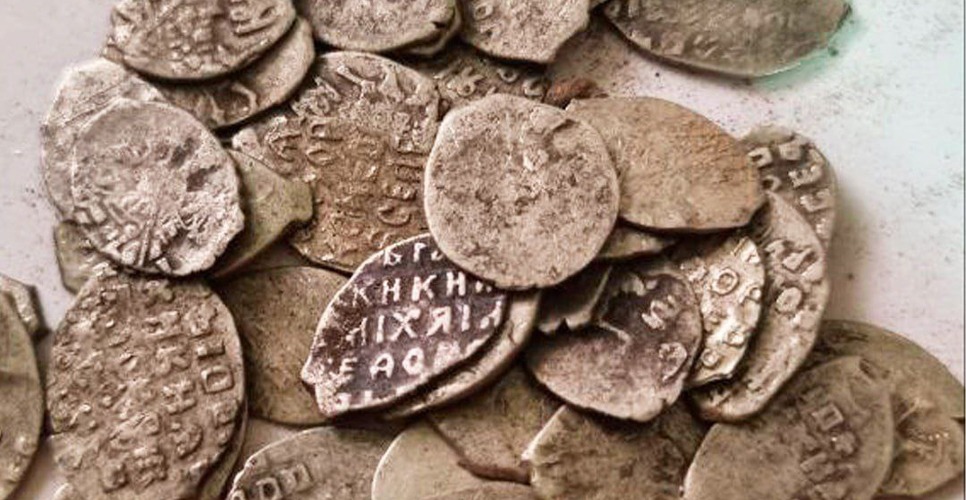
On 7 February 2026, restoration workers cutting through the floors of a historic building on Moscow’s Bersenevskaya Embankment felt something give way beneath their tools. In a cavity between the first and second floors lay a large ceramic jug — cracked and broken, its contents spilling into the surrounding earth. Inside and alongside it: thousands upon thousands of small silver coins, each no bigger than a fingernail, in remarkable condition with clearly legible stamps.
The jug belonged to Averky Kirillov — a powerful 17th-century Moscow official who oversaw the state treasury, managed trade, and collected taxes for the Tsar. He lived here, in these very chambers directly across the Moscow River from the Kremlin, at the peak of Russian political life. The coins, archaeologists believe, were hidden during the Streltsy Revolt of 1682 — the day before Kirillov himself was killed.
The reason why becomes clear from a single, chilling detail that emerged when archaeologists examined the hoard: not a single coin was minted after 1682. That was the year of the bloody uprising in which Kirillov was killed on 16 May by a mob of soldiers. Someone — perhaps Kirillov himself, in desperate haste — packed the coins into the jug and hid it between the floors. No one ever came back for it.
The Numbers
The scale of the find kept growing as experts worked through the hoard. Initial estimates put the count at around 20,000 coins. The final tally, announced at the Museum of Moscow: 85,553 silver coins — making it the second-largest purely monetary hoard ever found in Moscow’s archaeological history. The largest — unearthed at the Old Merchant Arcade (Stary Gostiny Dvor) in 1996, and also held at the Museum of Moscow — contained over 95,000 coins alongside 16 silver vessels.
The coins are small, flat, irregular slivers of silver known in Russian as cheshuyki — “fish scales” — hammered out by hand. The collection spans more than two centuries of Russian history: the bulk are kopecks from the reigns of Tsars Mikhail Fyodorovich (1613–1645), Alexei Mikhailovich (1645–1676), and Fyodor Alexeyevich (1676–1682). The oldest piece is a half-kopeck from the reign of Vasily II the Dark (1425–1462), a reminder that even centuries-old coins remained in everyday circulation long after attempts to withdraw them.
At 17th-century prices, the entire hoard represented a fortune comparable to the annual budget of a provincial Russian city.
The Building and the Man
The chambers of Averky Kirillov are one of Moscow’s oldest surviving civilian structures, sitting metres from the riverbank with a direct view of the Kremlin’s towers. Kirillov himself was a figure who embodied the contradictions of his era. He came from a family of royal gardeners — a nominal hereditary title — but had built himself into one of Moscow’s wealthiest merchants, owning dozens of trading shops across Russia and salt-works in the Urals, before the state recruited him into government service. From 1677 he headed the State Treasury, the Palace Administration, and several other institutions overseeing the country’s finances, trade, and industry — making him, in effect, one of the most powerful financial officials in Russia.
He was killed on 16 May 1682, accused of taking bribes and of unjust taxation. Historians note, however, that no documentary evidence of his corruption has ever been found — the charges may have been a pretext in the brutal factional violence of the uprising.
The neighbouring Church of St Nicholas on Bersenevka, which Kirillov largely funded and which stood connected to the chambers by a covered walkway, served as the Kirillov family burial place. Averky was interred there in 1682.
The current restoration, ongoing since 2024, is what finally gave up the secret. Workers also found, alongside the coins, fragments of polychrome ceramic tiles, a bone whistle, and a small pectoral cross.
Where to See It
Since 25 March 2026 the coins and the reconstructed jug have been on permanent display at the Museum of Moscow as part of the “History of Moscow” exhibition. Restoration of the Kirillov chambers continues.