


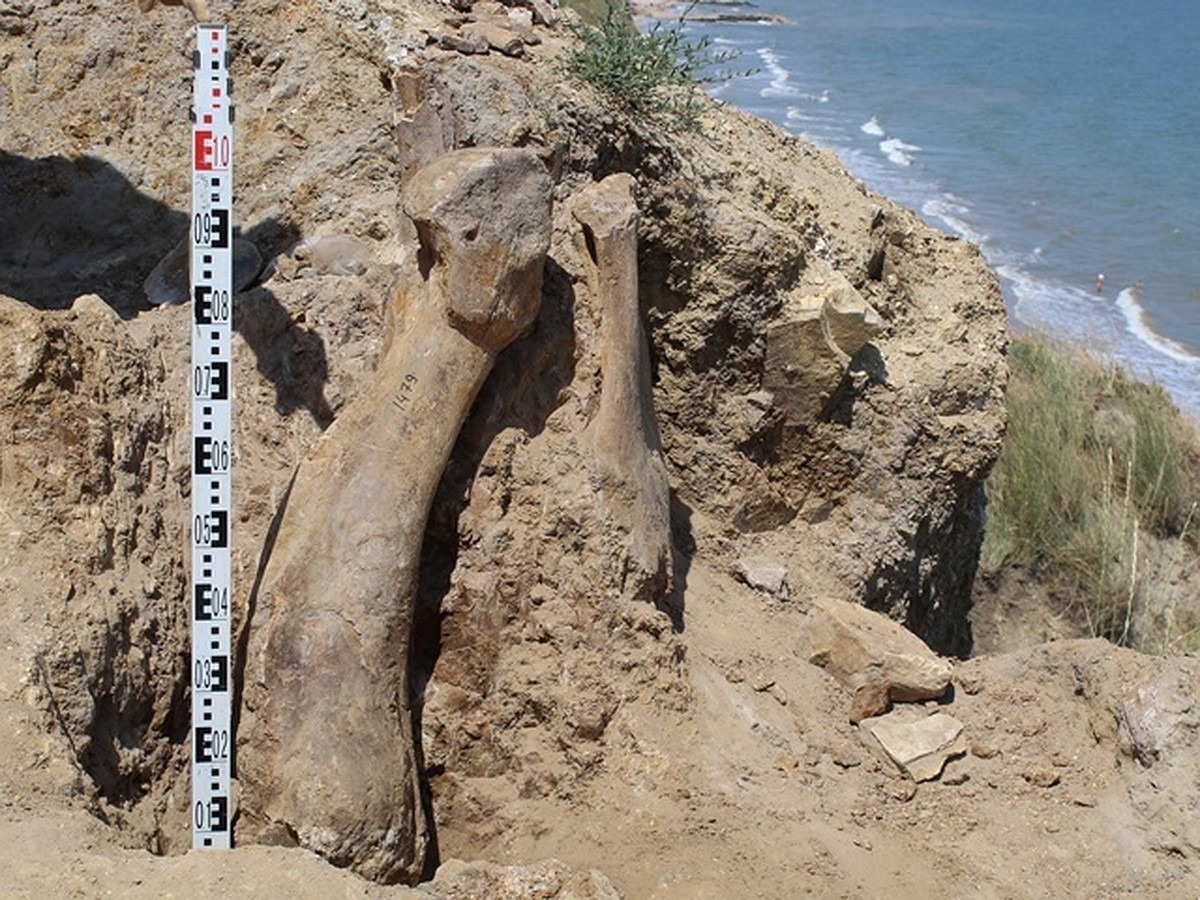
On a crumbling shoreline in southern Russia, scientists have lifted parts of six elephant skulls out of the ground. The animals died more than a million years ago — and something was standing over their bodies with a stone tool in its hand.
The dig sits on a low cliff on the Taman Peninsula, a flat, windswept wedge of southern Russia between the Black Sea and the Sea of Azov, a shallow inland sea to its north. There is not much to look at: dry grass, a small fishing village, and a brown bluff dropping into grey water.
Cut into that bluff is one of the strangest bone deposits in Eurasia. In one small patch of ground, researchers have uncovered the remains of roughly 100 elephants and 40 giant rhinoceroses — and, scattered among their bones, chipped stones shaped by human hands. The site is called Bogatyri/Sinyaya Balka.
This July, after a three-year pause, a team from the Southern Scientific Centre of the Russian Academy of Sciences went back. They returned not because they wanted to, but because they had to. The sea is taking the site apart.
“This year, after a three-year break, rescue excavations were continued at the unique locality of Bogatyri/Sinyaya Balka, which sits on an abrasion coast — a shoreline being destroyed by water,” said Vadim Titov, the palaeontologist who led the expedition and heads the palaeogeography laboratory at the Southern Scientific Centre. “What is special about this year’s dig is that we managed to excavate and lift parts of six elephant skulls.”
Six is a remarkable number. Elephant skulls are mostly air: honeycombed bone built for lightness rather than strength. After a million years underground they have the structural integrity of a wasp nest. Recovering six in one season is less a matter of digging than of engineering.
What, exactly, was the animal?
The species is Archidiskodon meridionalis tamanensis — in Russian usage, the “Taman elephant.” Most specialists elsewhere file it under a different genus name, Mammuthus meridionalis, known in English as the southern mammoth.
The distinction matters, because most coverage has called the animal “an ancestor of the mammoth.” It is more accurate to say that it was a mammoth, one of the earliest kinds — though not, strictly, on the line that led to the woolly mammoth. That branch had already split off in eastern Asia before these Taman animals were alive. They are close relatives of the woolly mammoth’s ancestors rather than the ancestors themselves.
Southern mammoths were not the shaggy creatures of ice-age cave paintings. They lived in warm, open grassland and probably had little more hair than an Indian elephant does today. They were also far bigger: a large male stood around 4 metres at the shoulder and could weigh 10 tonnes or more — roughly half again the height of an average Indian bull elephant, and about two and a half times its weight.
Sharing the site with them was Elasmotherium caucasicum, a rhinoceros around five metres long with a massive bony dome on its forehead — the animal whose Siberian cousin is popularly known as the “Siberian unicorn.”
A mud trap and a stone toolkit
The reason so many enormous animals are packed into one small area is not that they lived there. It is that they died there.
Around 1.2 to 1.4 million years ago, this spot was a boggy crater lake formed by a mud volcano — a vent that pushes out cold, semi-liquid clay rather than lava. Large animals came to the water, sank into the sticky sediment and could not get out.
Then somebody with sharp stones arrived.
The tools found among the bones are simple, heavy and old: choppers and flakes struck from local rock. Researchers disagree over what to call the tradition, but either way it is first-generation technology, far cruder than anything our own species has ever made.
Who made it is the harder question. The toolmakers’ own bones have never been found here — only their work. Researchers attribute the tools to Homo erectus or a close relative; Titov’s team uses the name Homo ergaster, which some specialists treat as a separate species and others as simply an early variety of Homo erectus.
There is also a live debate about what these people were doing. One reading is that they were opportunists, moving in on animals already dying in the mud — a low-risk way to obtain several tonnes of meat. Another, argued by the archaeologist Vyacheslav Shchelinsky, who has worked on the Taman sites for decades, is bolder: that they were genuine hunters of elephants and rhinoceroses. The difference bears directly on how capable and how organised the first Eurasians were.
Why a shoreline in Russia matters to everyone’s story
Our species evolved in Africa. But the genus Homo left Africa long before Homo sapiens existed, and reconstructing that first departure is one of the central problems in the study of human origins.
The anchor point is Dmanisi in Georgia, where skulls dated to about 1.8 million years ago show early Homo already established outside Africa. Beyond it the record thins out fast: the earliest firm human fossils in western Europe come from Atapuerca in northern Spain, at 1.4 to 1.1 million years, and comparable early sites are scattered thinly across Eurasia — among them Attirampakkam near Chennai, where stone tools have been dated to roughly 1.5 million years ago.
Bogatyri/Sinyaya Balka belongs to that small club. At more than a million years old, it is among the oldest evidence of a human presence anywhere in Europe, and it offers something the fossil-poor sites cannot: not a bone, but a behaviour. A place where you can see, in the ground, what early humans did when they met the largest animals on the landscape.
The clock
The problem is that the site is on a cliff, and the cliff is losing.
Waves undercut the base, the face collapses, and the deposit spills onto the beach. Titov has been blunt about the timeline, warning that within two or three years there may be nothing left of this bone bed and its stone tools. That is why the 2026 season was formally a rescue excavation — archaeology done against a deadline set by physics rather than by a research plan.
The six skulls have gone to the Azov Museum-Reserve, some 270 kilometres to the northeast, for conservation and storage. Cleaning bone this fragile takes months; the scientific description will take longer.
Which brings the necessary caution. Everything reported here comes from statements by the expedition team, released through the Southern Scientific Centre and the Institute for the History of Material Culture in St Petersburg. No peer-reviewed paper on the 2026 season exists yet, and the headline figure — roughly 100 elephants and 40 rhinoceroses — is the cumulative total from decades of work at the site, not the haul from a single summer.
What this summer produced was parts of six skulls, lifted from a cliff that is falling into the sea. Given the deadline, that is not a modest result. It is a salvage operation on a piece of the human record that will not be there to dig twice.
