

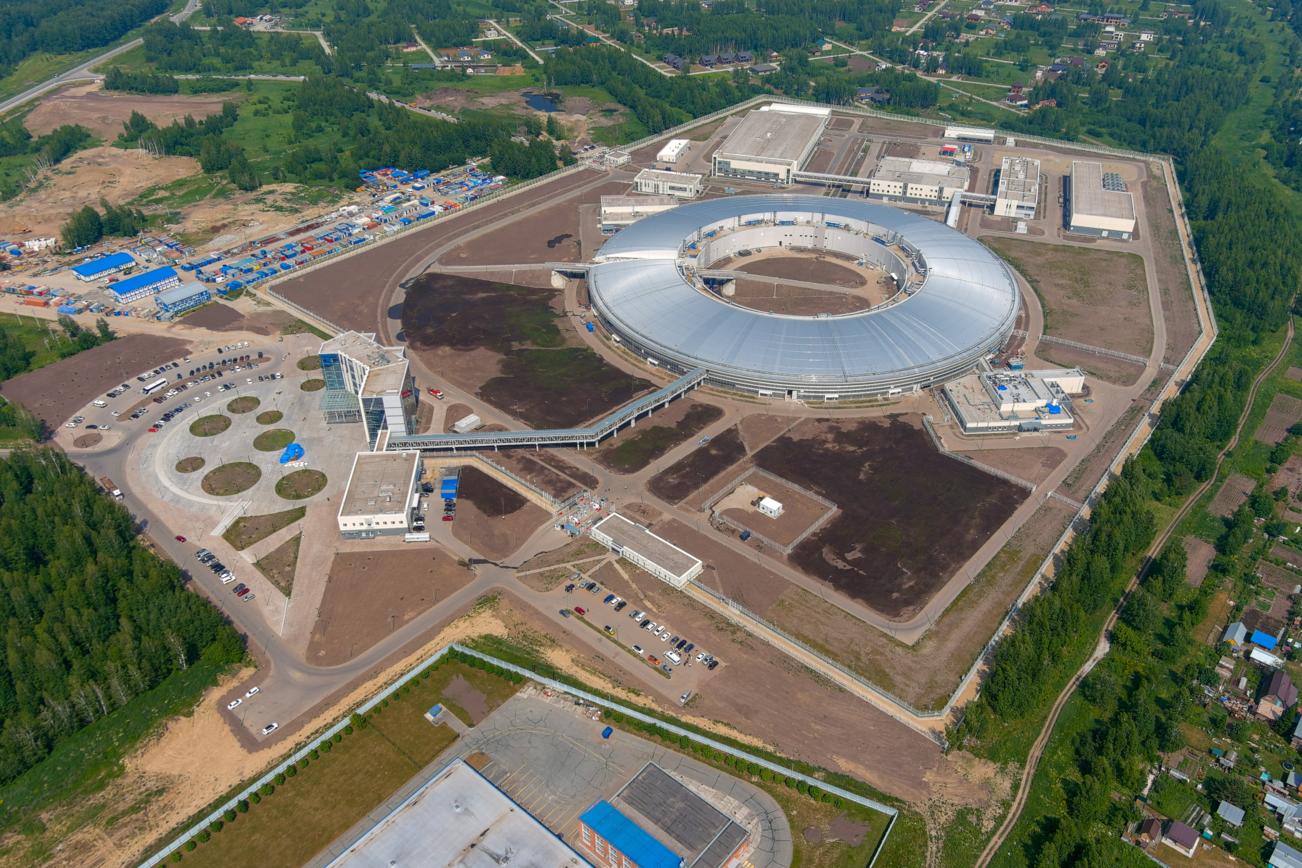
A $560-million synchrotron rose outside Novosibirsk after key foreign suppliers walked away. Now comes the harder part: making it produce science.
In a science town outside Novosibirsk, Siberia, Russia this week unveiled the largest research facility it has built since the Soviet era: a fourth-generation synchrotron light source called SKIF, a Russian acronym for Siberian Ring Photon Source that also spells the Russian word for “Scythian.”
President Vladimir Putin toured the complex in the town of Koltsovo on August 11 and signed a commemorative plaque before chairing a meeting of his Council for Science and Education — the ceremonial capstone on a project that has taken eight years and about 47 billion rubles, roughly $560 million at current exchange rates, though the budget was fixed in 2022 prices.
A synchrotron is, in essence, an X-ray microscope of extraordinary power. Electrons are generated in a linear accelerator, boosted to 3 giga-electronvolts in a booster ring, then injected into a main storage ring 476 meters around, where magnets force them to shed intense X-ray light. That light lets researchers watch matter atom by atom: how a protein folds, how a catalyst works mid-reaction, what sits inside an ancient artifact without cracking it open. Dozens of synchrotrons operate worldwide, but only a handful belong to the newest, fourth-generation class, defined by an ultra-tight electron beam. Sweden’s MAX IV came first in 2016, followed by Brazil’s Sirius and the upgraded European facility ESRF-EBS in 2020, then the rebuilt Advanced Photon Source in the United States in 2024. Switzerland’s SLS 2.0 and China’s HEPS are close behind. SKIF joins this short list, with a design beam quality — an emittance of 75 picometer-radians — among the best in its energy class. Russian officials call it “the world’s best source of this radiation in the medium energy range.” That is a claim about design parameters, not yet a measured result.
The klystron problem
The machine was never meant to be an import. The Budker Institute of Nuclear Physics in Novosibirsk, which designed the accelerator, has built such hardware for decades, and its director, Pavel Logachev, said in 2022 that imported materials accounted for only about 20 percent of the institute’s costs on the project, with roughly 10 percent of equipment bought in Japan and Europe — mostly to save time, not because Russia lacked the know-how.
But some of that 10 percent was irreplaceable, and the clearest case involves klystrons: high-power vacuum tubes that feed the linear accelerator, without which no machine of this class can run. Only three companies in the world made klystrons with the required specifications — CPI in the United States, Thales in France and Canon in Japan. SKIF had a signed contract with Canon, which the company tore up in 2022, after delivering just one of the four tubes required. “We had worked on this in the background for many years, but since one could simply buy it, we had no strict motivation,” Logachev said at the time. By May 2023 the institute’s own prototype hit the design power of 50 megawatts, and serial production began — making Russia the fourth entity on that list of three.
Speaking at the council meeting, Putin acknowledged the launch had been pushed back in part because foreign-made components never arrived, and said Russia had built about 30 categories of critical equipment on its own — emerging, he argued, with deeper engineering competence than before. Under the government’s original decree, the accelerator and a first beamline were due in 2023, with commissioning in 2024; the slip cost more than two years. Whether that trade reads as a sanctions failure or an industrial-policy success depends on the ledger: the machine exists and the capabilities are real, but the years are gone, and the sanctions-made-us-stronger thesis is easier to test in accelerator hardware than in the science the machine has yet to produce.
Opened, not yet running
The ribbon-cutting came with an unusually candid asterisk from the scientists themselves. “This was an opening ceremony, not a commissioning ceremony,” Valery Bukhtiyarov, director of the Boreskov Institute of Catalysis, which operates SKIF, told reporters the next day, adding that bringing such a machine online “will take quite a long time.”
The near-term physics schedule, per Logachev: the electron beam is already entering the main ring at full design energy; first synchrotron light is expected around the turn of September; a first experiment should run by September 25 and a second in late October; in December the machine is to operate with its full set of insertion devices, the magnet arrays that generate the most brilliant light. The seven beamlines of the first phase are to reach design performance over the course of 2027, when round-the-clock user operation is slated to begin. Work is under way on ten more stations, with an eventual target of 30.
The staffing math is its own constraint. “We already have 350 qualified people,” said Evgeny Levichev, SKIF’s director. “We need to hire another 100 over the next year so the whole complex can work as intended — 24 hours a day.”
A different map of collaboration
Synchrotrons have always been the most international genre of big science: too expensive for one lab, useful to thousands of visiting research groups. Before 2022, Russia was embedded in that world — a state-level shareholder in the European XFEL laser in Germany and a member of the European synchrotron in Grenoble, France. Those channels have largely closed.
What replaces them was visible in the meeting transcript. Mikhail Kovalchuk, president of the Kurchatov Institute and the program’s chief ideologue, reported that SKIF has been folded into a Russia-based international research center whose official participants are Belarus, Iran, Uzbekistan and China, with Kazakhstan, Tajikistan, Brazil and Indonesia in talks. Chinese institutions, he noted, have filed three membership requests; the Chinese Academy of Sciences has already been admitted. A world-class light source is being wired not into the Grenoble-centered network of Western facilities but into a parallel circuit running through Minsk, Tehran and Beijing — arguably the week’s most consequential detail.
What it’s for
The intended applications are the ones driving synchrotron construction everywhere: protein structures for drug design, catalysts and battery materials, alloys for aircraft engines, non-destructive imaging of archaeological finds. Officials say industrial heavyweights — the Kalashnikov Concern, Tatneft, the United Engine and United Aircraft corporations, Roscosmos — have signed agreements to use the country’s synchrotron and neutron facilities and to fund their own experimental stations. Beam time itself will follow the standard synchrotron model: researchers compete through peer-reviewed proposals and pay nothing, provided they publish; commercial clients who want their results kept private pay for the privilege. Novosibirsk semiconductor researchers have pitched an additional station to prototype X-ray lithography for chip manufacturing — another field where Russia is cut off from Western technology — though SKIF’s management notes it is not yet on the approved list.
All of that remains prospective. The honest measure of SKIF will not be the plaque signed this week but something duller and slower: the papers, patents and molecular structures that come out of beamlines one through seven — starting, if the schedule holds, before this month is out.