


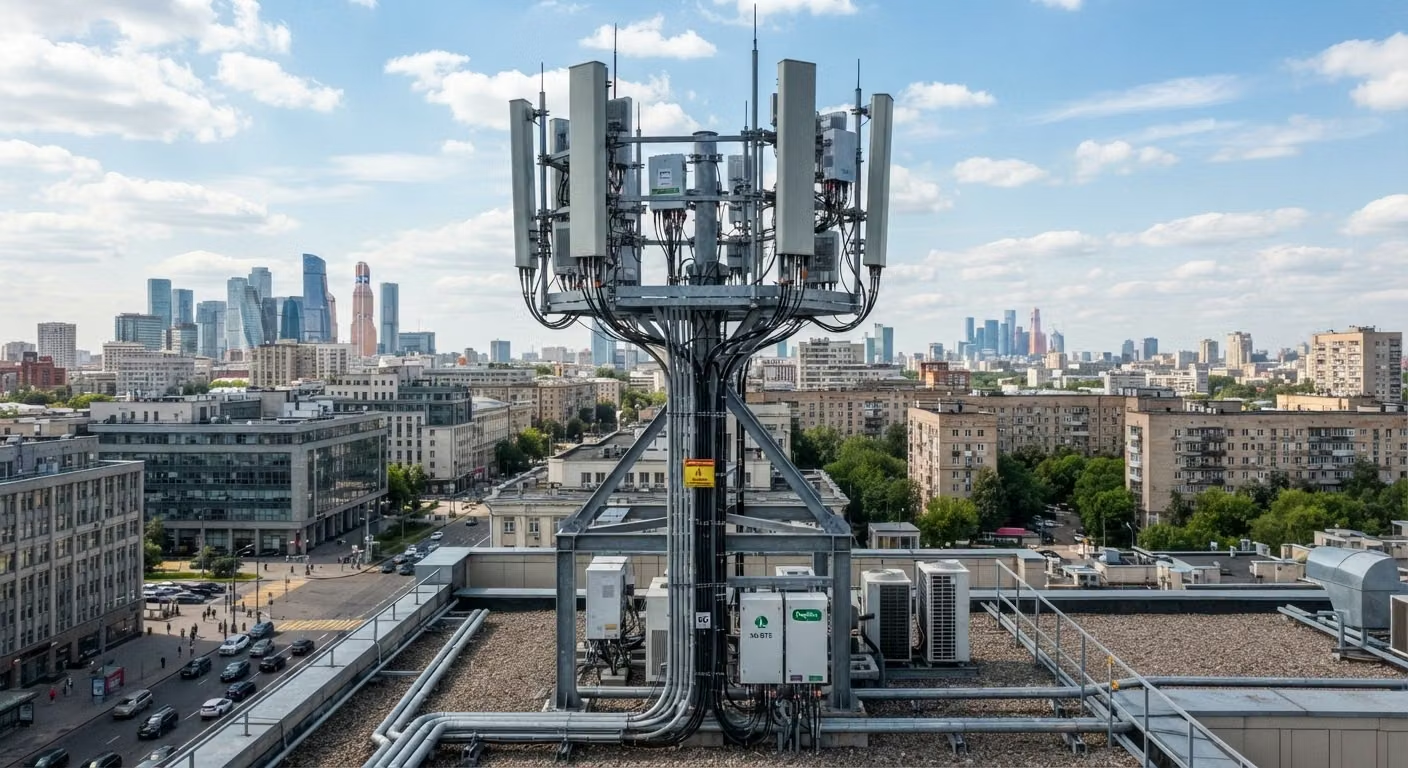
On 31 August the State Commission for Radio Frequencies, the interdepartmental body that allocates spectrum in Russia, settled a question the government had left open since 2019: on what terms the country’s mobile operators may switch on fifth-generation networks.
The terms, announced by the Ministry of Digital Development, are worth reading closely. MTS, MegaFon, VimpelCom (which trades as Beeline) and T2, the former Tele2 Russia, may deploy 5G on the radio frequencies they already hold, spectrum originally licensed for 4G. This is the principle of technological neutrality: rather than receiving new bandwidth, an operator runs the new standard inside the frequencies it is already using. They may do so on foreign base stations, provided those stations were installed and commissioned before 1 September 2026. Each will also receive 90 MHz in the 4.63–4.99 GHz range, without an auction. That is the whole of the allocated range, split four ways.
The ministry says networks built on this basis should appear in cities of more than a million people “in the very near future”. Services in the new band are to launch in the busiest locations of those cities by the end of 2028 and expand over the three years after that. From 2027 operators are to begin a phased switch to Russian-made base stations, to be completed by the end of 2031.
This is a late arrival. The GSA, an industry body that tracks mobile network rollouts worldwide, counted 392 operators running commercial 5G networks at the end of March 2026, up 14% in a year. Russia, a market of about 146m people, has until now had nothing beyond engineering trial zones.
The band that never came free
The obstacle was always a slice of radio spectrum between 3.4 and 3.8 GHz.
Known in the industry as band n78, or the golden band, it is the range on which most of the world’s 5G networks are built. It offers the best available trade-off between how far a signal travels and how much data it carries, and most 5G handsets sold outside China and Japan are designed around it.
In Russia those frequencies are occupied by state users: radar, satellite and special-purpose communications. The agencies holding them have declined, repeatedly and successfully, to release them. Operators have been lobbying for the band since 2019.
What was offered instead was band n79, the 4.4–4.99 GHz range from which the new allocations are carved, used mainly in China and a few other Asian markets. Higher frequencies do not travel as far: signals fade faster and penetrate buildings less effectively, so covering a given area takes substantially more base stations. Operators have argued for years that n79 works as a capacity supplement but not as the backbone of a national network. Nor has the 700 MHz band, used elsewhere to carry 5G over long distances and into rural areas, been released.
The auction that never happened
As recently as 2025 the government intended to sell the 4.8–4.99 GHz spectrum at auction in two lots, with starting prices of 26.2bn and 21.2bn roubles ($302m and $244m), or 47.4bn roubles ($546m) in total. Operators refused to bite. They put the payback period on networks in that band at 20 to 30 years. In October 2025 the ministry cancelled preparations for the sale and began discussing an alternative: letting operators run 5G on their existing 4G frequencies instead.
Ten months later that is precisely what happened, and the spectrum the state hoped to sell for half a billion dollars is being handed over free, in a slice nearly twice as wide as the one it had planned to auction. Leonid Konik, a partner at ComNews Research, argues that operators do not particularly need frequencies at 5 GHz in the first place, which makes the width of the allocation close to immaterial to them.
The 1 September clause
The most consequential line in the decision is a date: foreign base stations qualify only if they were installed and running before 1 September 2026.
That clause exists because of sanctions. Nokia and Ericsson, which between them accounted for close to half the base stations in Russian networks, completed their exit at the end of 2022; Huawei stopped selling new equipment for fear of secondary sanctions. Operators have since been running on stockpiled hardware and a domestic supply chain assembled in a hurry.
Grandfathering the installed base solves an immediate problem, since much of that Western equipment is already 5G-ready and can in principle be switched on in software within weeks. It creates a longer-term one. Eldar Murtazin of Mobile Research Group called the ruling a gift from the ministry and said it puts an end to the development of Russian 5G base stations for the foreseeable future, since operators can meet the near-term targets with kit they already own. He does not doubt domestic equipment will arrive eventually. In the meantime, he expects commercial 5G service in Russia before the end of this year.
The domestic vendors are real but small. Irteya, a subsidiary of MTS, began serial production in October 2024; by May 2026 around 1,500 of its base stations were in commercial service with MTS and Beeline, and it aims for 4,000 by the end of this year. Yadro started serial output in December 2025. Bulat, backed by the state-controlled Rostelecom, has roughly 2,000 GSM and LTE stations running on T2’s network under a rural coverage programme. Every foreign base station across four national networks is due to be replaced by the end of 2031.
What subscribers will actually get
Very little, at first. Technological neutrality means 5G sharing the same spectrum as 4G rather than occupying new bandwidth, so for most subscribers the practical effect will be a logo change on the status bar rather than a step change in speed. Aleksei Boiko, an independent telecoms analyst, argues that the mechanism lets operators launch at reasonable cost on hardware they already own while delivering almost no gain in access speeds.
Measurements bear this out. Vigo, which analyses network data from some 12m devices in Russia, found that in July 2026 fewer than 0.1% of user sessions ran on 5G, a signature consistent with scattered trial cells rather than a functioning service. For comparison, Opensignal data cited in the same study show European users spending 14.5% of their connected time on 5G in the first quarter of 2026, and within reach of a 5G signal 78% of the time, at average speeds of 191.7 Mbps against 62 Mbps on 4G.
Handsets are a separate obstacle. Vigo found that about a quarter of unique devices in Russia, and 29% in Moscow, can actually connect to Russian 5G as specified, accounting for roughly a fifth of all sessions. The gap between formal 5G support and usable support is n79: the band appears mainly in Chinese-market versions of Xiaomi, Huawei and Honor handsets, while global Samsung variants lack it. Apple is a harder case still. iPhones have supported 5G since the iPhone 12, but the feature is enabled in firmware only after Apple certifies a given operator’s network, certification that Russia’s big four are unlikely to obtain.
The real prize may be industrial
That points to where the new spectrum is likely to be used first. MegaFon says it expects the largest early gains in the corporate and government segments, and has already tested migration scenarios for private client networks. Konik goes further, expecting operators to deploy the new frequencies in limited zones rather than for public coverage: a factory, a port, a quarry or a mineral deposit. Spectrum that does not travel far is a liability across a city and an asset inside a fenced perimeter, where dense small cells, low latency and guaranteed capacity are what the customer is buying.
It is a coherent business, if a smaller one than the ministry’s language implies. MTS chief executive Inessa Galaktionova, welcoming the decision, said her company had spent 50bn roubles ($576m) on network modernisation in recent years and had been preparing for 5G for a decade.
What to watch
A draft of the roadmap that circulated in May set interim localisation thresholds alongside the coverage dates, including at least 1% Russian radio equipment by the end of 2027, at least 50% by 2030 and a full transition a year later.
Those requirements sit awkwardly with the incentive the ministry has just created. Operators have five years to strip out imported equipment they have simultaneously been encouraged to build on, and to replace it with domestic gear whose producers are still counting output in the low thousands. Which commitment gives way first will say more about Russian industrial policy than any ribbon-cutting in a million-plus city.

