
Before a single frame was shot, Roman Mikhailov did something unusual: he gathered his Indian cast in a room and played Andrei Tarkovsky’s Mirror in complete silence. For most of the actors — including Manasvi Mamgai, the former Femina Miss India 2010 — it was their first encounter with Russian auteur cinema. The reaction, Mikhailov later recalled, was exactly what he had hoped for: confusion, wonder, and the slow dawning that they were about to work in a cinematic language unlike anything they knew.
This was how the filmmaker — a doctor of physical and mathematical sciences and professor at the Russian Academy of Sciences who once specialised in homological and homotopical algebra before turning to cinema — prepared to shoot Pesni Dzhinnov (“Songs of the Djinns”). The film is his third made in India, and the closing chapter of an ambitious project to produce ten films in seven years. It premiered on April 18 in the “Russian Premieres” competition at the 48th Moscow International Film Festival.
Why India?
The answer has little to do with exotic backdrops. Mikhailov — who has built a devoted cult following in Russia, with some admirers reaching for comparisons to the late Alexei Balabanov — seems drawn to India for something harder to name: a rhythm and a sense of time that a Moscow soundstage cannot provide. Varanasi, with its rituals of death and rebirth, and Goa, with its ashrams and endless festivals, function less as settings than as collaborators that dictate the tempo of the work. The director has called India his “second homeland,” recalling that he first travelled there 23 years ago and has since worked in Delhi, Allahabad, Chandigarh, Mumbai and Guwahati.
His two earlier India-shot features, Zhar-ptitsa (“Firebird”) and Nado snimat filmy o lyubvi (“We Must Make Films About Love”), both became festival talking points and cemented his reputation as a filmmaker willing to build entire production ecosystems abroad rather than import a Russian crew into a foreign country for two weeks. Songs of the Djinns is also his first international co-production, made together with the Indian company Respect India Entertainment.
A Month Before the Camera
What makes Mikhailov’s method genuinely unusual is his insistence on what he calls the “acquaintance stage.” For a full month before shooting began, there was no camera work at all. Instead, he screened European arthouse films, Russian classics, and his own earlier work for his cast, which included Indian leads Vyom Yadav and Manasvi Mamgai alongside Russian actresses Viktoria Miroshnichenko and Anastasia Neginskaya.
The culture gap was real, particularly around physicality. Indian acting traditions — from the classical principles of the Natyashastra through to Bollywood — rest on a foundation quite different from the Russian psychological school. Mikhailov has said that bridging those two bodily vocabularies was his biggest early worry. By the time cameras rolled, he claims, “everything just flowed.”
Yadav, who travelled to Moscow for the festival, added a curious detail about his director: Mikhailov, he said, speaks not only fluent Hindi but also Sanskrit — well enough to use words that most Indians themselves no longer know.
A Fairy Tale in Four Chapters
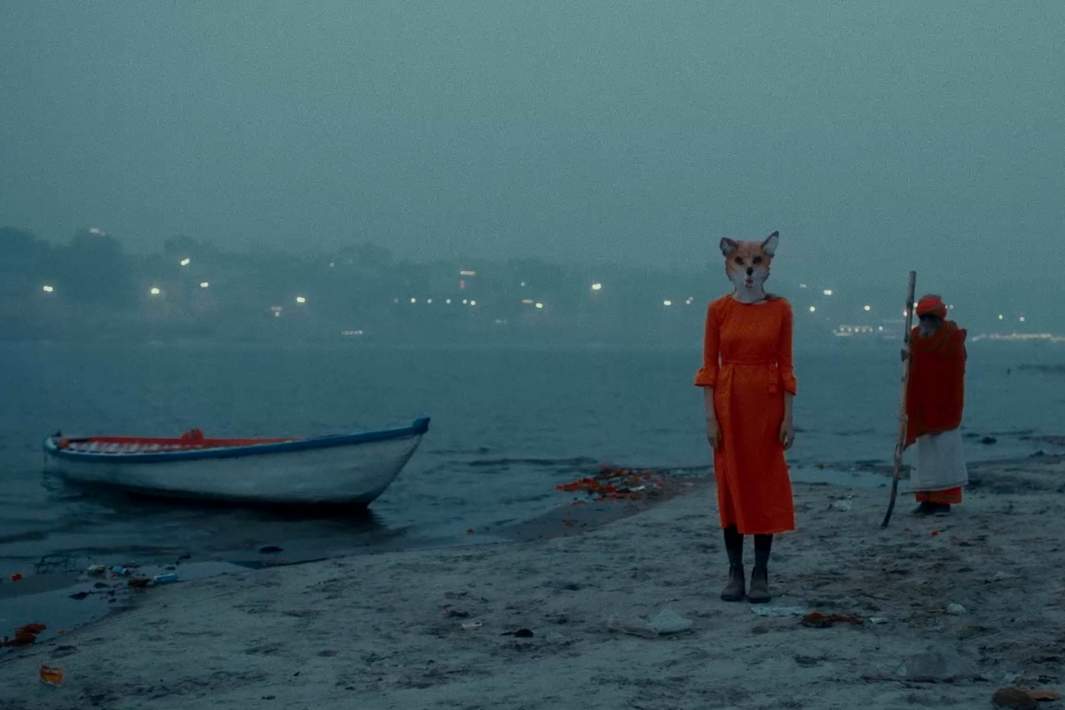
The film itself is structured as four loosely interwoven chapters, which the director associates with the four elements. Two actresses wander nighttime Varanasi on New Year’s Eve, trading confessions about childhood fears and industry parties. In Goa, an enterprising local (played by Yadav) agrees to organise a last-minute concert for Russian pop singer Yulia Volkova — the former member of t.A.T.u. who appears as herself. Eventually, the characters converge on a boat drifting down a quiet river in the dark, while ruined palaces, wandering magicians and touring DJs listen for the song of the djinns.
Mikhailov has described fairy tales as necessarily containing a kind of delirium — a garment the story wears to deliver something deeper. At the heart of every such tale, in his view, is the disenchantment of the world through love. He has even written a companion book, also titled Songs of the Djinns, to accompany the film’s release.
The soundtrack, which he worked on for over a year, weaves together techno, trance, toccatas from Bach’s Brandenburg Concertos, and contemporary electronic compositions by Oleg Gudachev, Natalia Solovyova and QT (Anatoly Kapitonov) into what he wanted to feel like the song of a single strange creature — possibly a djinn itself.
Next Stop: Bengal
Songs of the Djinns closes the India cycle, but not Mikhailov’s engagement with the subcontinent. His producer Yulia Vityazeva has confirmed the next film will be shot in Bengal.
There is something quietly significant about the whole enterprise. Rather than parachuting in to capture local colour, Mikhailov begins each project by sitting down with his collaborators to watch films together for a month. It is cinema as a humanitarian technology — a slow, careful way for two cinematic traditions to find a shared language, one screening at a time.