

The 300 MW Novolakskaya plant in Dagestan marks a milestone for a wind industry that had to reinvent itself after Western companies walked away.
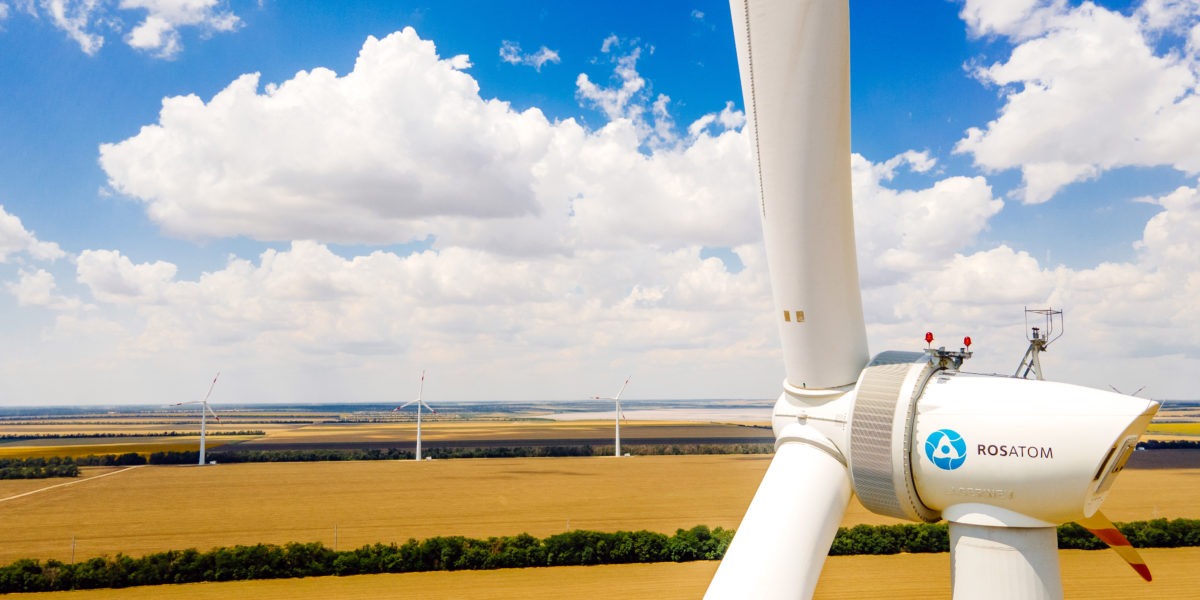
On a windswept stretch of Russia’s North Caucasus, 120 turbines are now feeding power into the national grid. The Novolakskaya wind farm, officially launched on July 22 in Dagestan’s Kumtorkalinsky and Novolaksky districts, has a combined capacity of 300 megawatts — making it the largest wind power plant in Russia.
The project was built by the wind power division of Rosatom, Russia’s state nuclear corporation, and is expected to supply electricity to more than 240,000 households — roughly 9 percent of Dagestan’s total consumption. Planned annual output is about 879 million kilowatt-hours, or nearly 0.9 terawatt-hours.
Each of the 120 turbines stands as tall as a 50-floor building and weighs over 320 metric tons.
A record with a backstory
The plant came online in two stages. The first phase — 61 turbines totalling 152.5 MW — began delivering electricity to Russia’s unified grid in December 2025; the second phase added 59 more turbines with 147.5 MW in 2026.
That final push dethroned a title-holder of more than five years. The Kochubeyevskaya wind farm in neighboring Stavropol region — 84 turbines, 210 MW — had held the national record since its commissioning in December 2020.
According to Rosatom, 85 percent of the equipment is localized: the nacelles, generators, hubs and blades were all manufactured at the corporation’s own Russian plants. Rosatom’s renewables chief Grigory Nazarov called it the company’s first project with such a record level of localization — and its tenth wind farm overall.
Why 85 percent matters
Russia’s wind industry was, until recently, built on Western involvement: Denmark’s Vestas supplied and locally assembled turbines, while Finland’s Fortum and Italy’s Enel developed and co-financed wind farms. All three moved to leave Russia after 2022, forcing a postponement of the state renewables auction and a scramble to rebuild supply chains.
Rosatom’s answer was to pull wind manufacturing into its own industrial empire. Hubs, nacelles, generators and cooling systems for the 2.5 MW turbines are produced at the Atommash plant in Volgodonsk — a facility better known for making nuclear reactor vessels. The last missing piece was blades. A newly built plant in the Ulyanovsk region — the country’s first domestically owned blade production — pushed localization to the 85 percent mark, and its first blades were shipped to the Novolakskaya site.
For comparison, the Kochubeyevskaya plant launched in 2020 had a localization level of 65 percent. The 20-point jump in five years is, in effect, the story of an industry forced into self-sufficiency by sanctions — and, at least in this niche, delivering.
A drop in a very large ocean
As of January 1, 2026, the country’s renewables capacity stood at 7.21 gigawatts — up 10.6 percent year on year — of which wind accounted for 2.97 GW, little more than 1 percent of Russia’s installed generating capacity, in a system dominated by gas, nuclear and large hydro. Novolakskaya alone now accounts for roughly a tenth of the nation’s entire wind fleet — which says as much about the fleet as about the plant.
For Dagestan, however, the stakes are concrete: the republic has struggled with chronic power shortages for years — a point officials stressed at the launch ceremony, with the acting regional head, Fyodor Shchukin, presiding. The wind farm will employ around 70 permanent staff during operation.
What comes next
Rosatom is not stopping in Dagestan. The corporation has now commissioned more than 1.3 GW of wind capacity across ten plants, and plans to exceed 2 GW in total by 2028. It is also building its first wind farm abroad — a 100 MW project in Kyrgyzstan’s Issyk-Kul region, with Russian-made blades already being shipped.
A nuclear corporation assembling a vertically integrated wind business — from reactor-grade factories to composite blades — is an unusual industrial experiment. Whether it can compete on cost with Chinese turbine giants beyond the post-Soviet space is an open question. But within Russia’s sanctioned, import-starved market, Novolakskaya makes one thing clear: the country’s wind industry is now far less dependent on foreign hardware than it was just five years ago.

