


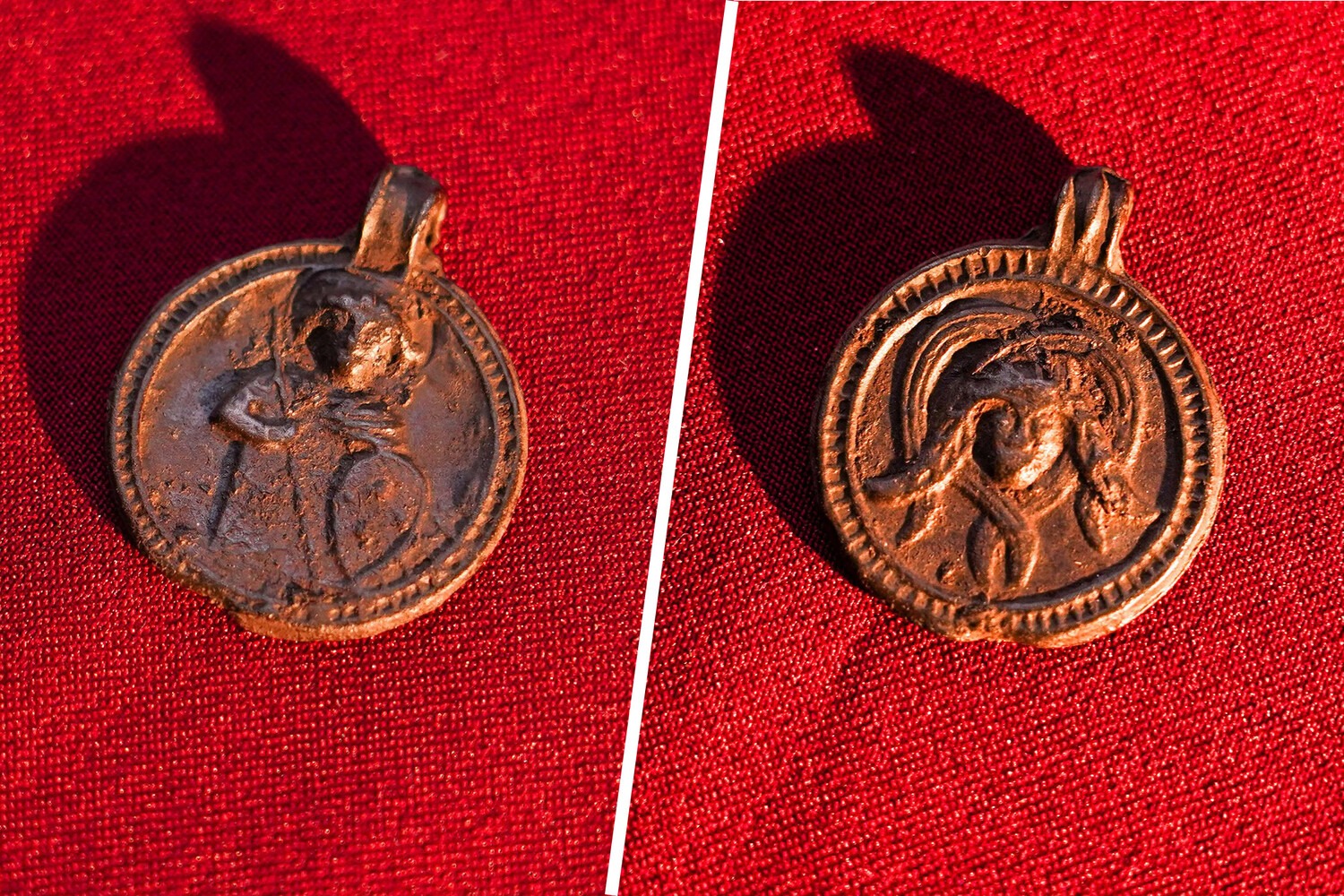
A copper pendant from Staraya Russa pairs a warrior saint with a snake-haired woman and pushes the town’s Christian history back by a century.
Turn it one way, and a warrior saint looks out with spear and shield. Turn it over, and a woman’s face stares back, crowned with writhing snakes.
Archaeologists from Novgorod State University found the double-sided pendant this summer at the Pyatnitsky excavation in Staraya Russa, a historic town in Russia’s Novgorod region. Dated to the 11th century, it is one of the oldest “serpent amulets” (zmeeviki in Russian) known from the medieval Novgorod lands.
What defines a zmeevik is a pairing that strict church doctrine would call “incompatible,” says Sergey Toropov, director of the university’s Center for Archaeological Research. The front always carries a canonical Christian image. The back carries a non-Christian serpent composition that traces back to the Medusa of Greek myth.
Here the front probably shows Saint Theodore Stratelates, an early Christian warrior saint revered in Byzantium and said to have slain a giant serpent. The snake-haired figure on the back may be less Medusa herself than a collective image of dark forces. Together, Toropov suggests, the two sides could symbolize “the victory of the forces of light over the forces of darkness.”
Some zmeeviki carry Greek incantations, which suggests they were most likely worn as protection against disease.
The fashion reached Rus from Byzantium and was worn at the very top of society. The famous gold Chernihiv hryvnia is often linked to Prince Vladimir Monomakh. The Staraya Russa pendant is humbler. It is made of a copper-based alloy and likely belonged to someone of middling means, since the poor couldn’t afford such an item and the elite wore silver and gold. It may even have been copied from another pendant in a workshop on the same estate.
Staraya Russa was once the second-largest city of the Novgorod lands, a medieval center of salt making, and later the model for Dostoevsky’s town in The Brothers Karamazov. Before this find, it had yielded only four zmeeviki, all from the 12th to 14th centuries. The new pendant pushes the local record back by at least a century.
According to the university, the find confirms that by the 11th century the town already had an established Christian community, active craft workshops and steady ties with Byzantium. That was only a few generations after Rus formally adopted Christianity in 988.
A thousand years on, the little pendant still makes you look twice. One side shows the new faith; the other, the old fears it promised to defeat.

