
Francis Halzen won this year’s physics prize for IceCube, a telescope built inside a cubic kilometre of Antarctic ice. The idea behind it dates back to 1960, and one of its three authors was a Soviet physicist. Russian institutes still lead a sister project deep in Siberia’s Lake Baikal.
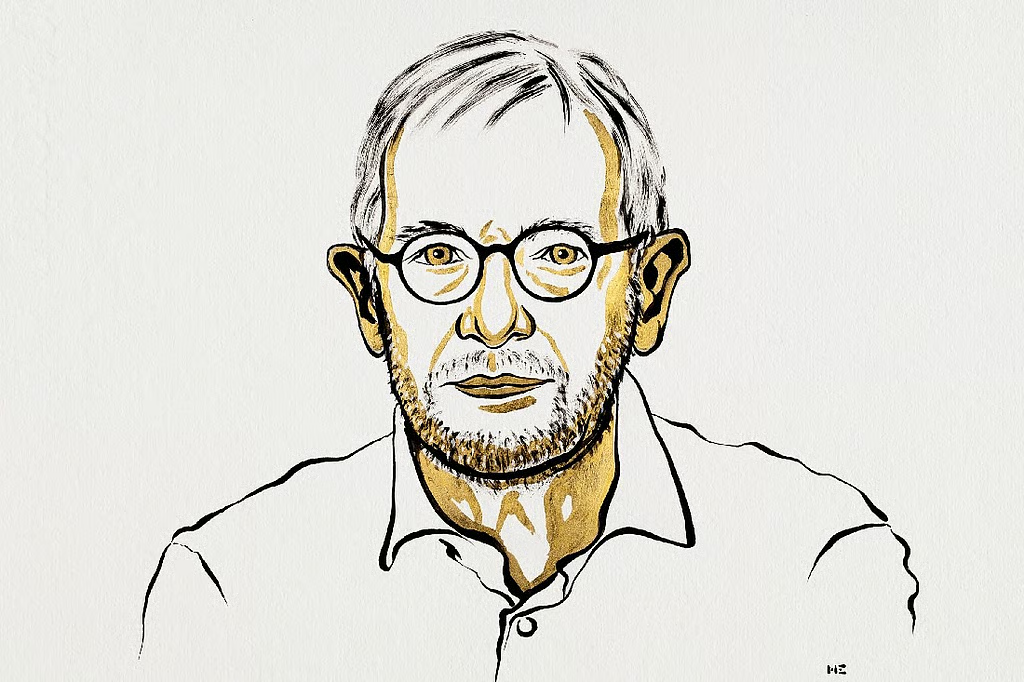
When the Royal Swedish Academy of Sciences announced the 2026 Nobel Prize in Physics on Tuesday, October 6, the winner was not in Stockholm. Francis Halzen, an 82-year-old Belgian-born physicist at the University of Wisconsin–Madison, spoke by phone from Italy in a call broadcast at the announcement and called the award a great surprise.
He wins alone, for what the Academy called “decisive contributions to the IceCube Neutrino Observatory and the discovery of high-energy neutrinos of astrophysical origin”. The prize is worth SEK 12 million (about $1.2 million), raised this year by SEK 1 million to mark the award’s 125th anniversary.
Mark Pearce, who chairs the Nobel Committee for Physics, praised Halzen for leading the international team that “provided us with a fantastic instrument”. It is also an unusual one: a telescope with no lens and no mirror, buried deep in the ice at the South Pole. To see why it works, and why part of its family tree runs through Moscow, Dubna and Siberia, one has to start with the particle it was built to catch.
Ghosts that rarely touch anything
Neutrinos are everywhere, yet they are among the hardest particles to detect. They carry no electric charge and almost never interact with matter, which is why physicists call them ghost particles. Vast numbers pass through the Earth, and through each of us, without leaving a trace.
That shyness is exactly what makes them valuable. Unlike other particles, as the Academy explains, neutrinos reach us without changing direction or losing energy. They carry information about the most violent places in the universe that is not available in any other way.
Catching one takes patience and sheer volume. Very occasionally a neutrino strikes an atomic nucleus and produces a charged particle that gives off a faint blue flash, known as Cherenkov light. In a large, dark and transparent medium, sensors can record that flash and work out where the neutrino came from. Since such hits are extremely rare, the detector has to be enormous.
A cubic kilometre of ice
Halzen’s insight, set out in a 1988 paper written with his colleague John Learned, was that nature had already built the detector. The ice beneath the South Pole is clear, free from many kinds of interference and geologically stable, with no earthquakes. There is also a great deal of it.
Turning that idea into an observatory took more than two decades. Today IceCube’s 5,160 light sensors hang on 86 cables at depths of 1,450 to 2,450 metres, filling a cubic kilometre of ice. The last cable went in during December 2010, and the observatory was fully running in 2011.
In 2013 IceCube reported the first high-energy neutrinos from deep space. That is the discovery the Nobel Committee has now rewarded.
An idea from 1960
The principle is almost three decades older than Halzen’s paper. According to the Nobel Committee’s own scientific background, the use of large volumes of water as a neutrino detector was proposed independently in 1960 by three physicists: Frederick Reines, Kenneth Greisen and the Soviet theoretical physicist Moisey Markov.
Some accounts give Markov a little more credit. Physics Today, published by the American Institute of Physics, describes him as the first to suggest using large natural bodies of water. Halzen’s own step was to swap liquid water for polar ice.
The water version never went away, however. In Siberia it has had a home since 1980.
A telescope in a Siberian lake
In 1980, at the suggestion of Markov and fellow academician Aleksandr Chudakov, physicist Grigory Domogatsky began work on a neutrino detector in Lake Baikal. Halzen himself has written that DUMAND, a pioneering project to build a detector under water, inspired the Baikal effort.
Domogatsky’s team built NT200, which the Joint Institute for Nuclear Research (JINR) in Dubna, near Moscow, describes as the world’s first deep-underwater neutrino telescope. Its much larger successor, Baikal-GVD, put its first cluster of sensors into the lake in 2015.
The letters stand for Gigaton Volume Detector, though colleagues liked to read them as the initials of Grigory Vladimirovich Domogatsky. He led the project until his death in December 2024, aged 83.
Built from the ice up
Baikal is a winter project. Every February, when the lake freezes hard, crews use the ice itself as a work platform. From it they lower strings of spherical sensors at a site 3.6 km offshore, where the water is about 1.3 km deep.
This year’s expedition of around 70 people began on February 17. JINR’s Igor Belolaptikov said the ice was more than 60 cm thick and almost perfectly flat. The crews added the telescope’s 15th and 16th clusters and a record 756 sensors in a single season, bringing the total to almost 4,900. The weather does not always cooperate: in 2025 difficult ice cut the work short by two weeks.
Since April 6, the detector has been collecting data with an effective volume of about 0.8 cubic kilometres. JINR director Grigory Trubnikov expects it to reach a full cubic kilometre, IceCube’s size, by 2028. More than 70 scientists and engineers from nine research centres in Russia, Kazakhstan, Slovakia and the Czech Republic work on the project, which JINR calls the largest neutrino telescope in the Northern Hemisphere.
Two telescopes, one galaxy
Today Baikal-GVD, IceCube and KM3NeT in the Mediterranean are the world’s three large neutrino telescopes in operation, and all three belong to the Global Neutrino Network.
The Antarctic and Siberian detectors have also pointed to the same corner of the sky. In 2017 IceCube linked a high-energy neutrino to TXS 0506+056, a distant active galaxy whose jet points towards Earth. It was the first time a single cosmic object had been associated with such a neutrino.
In April 2021 Baikal-GVD recorded a rare neutrino with an energy of about 224 teraelectronvolts (TeV) arriving from the same direction. Its scientists published the result in Monthly Notices of the Royal Astronomical Society. In a field that counts its best catches one by one, the independent detection supported the case that galaxies of this kind produce high-energy neutrinos.
Dubna got there first
Dubna recognised Halzen before Stockholm did. In September 2019, at a session of JINR’s Scientific Council in Dubna, he received the Bruno Pontecorvo Prize, named after the Italian and Soviet neutrino pioneer. The citation praised his contribution to building IceCube and to the experimental discovery of high-energy astrophysical neutrinos, wording strikingly close to the Nobel citation seven years later.
This year’s Nobel goes to one person. The science behind it is collective, spread across several continents and more than six decades. Halzen will receive his medal in Stockholm on December 10. Two months later, if the ice holds, the Baikal crews will be back on the frozen lake, extending a telescope whose story began with Markov’s suggestion.