


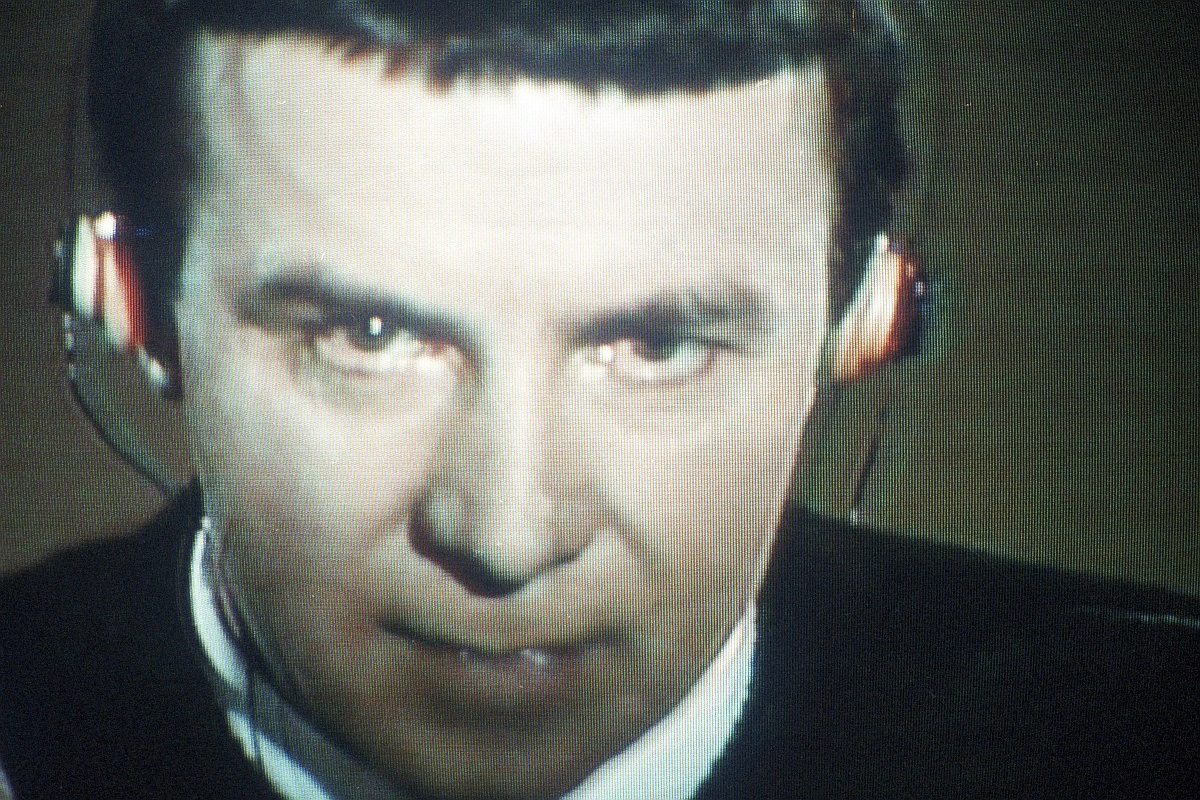
Anatoly Kashpirovsky, the Soviet psychotherapist who “treated” millions on live television in 1989, has died in Moscow aged 87. His story is less about hypnosis than about a country that had run out of things to believe in.
On the evening of Sunday 8 October 1989, families across the Soviet Union did something odd. They set jars of water in front of their television sets. Some pressed sore spots against the glass. Then, after the evening news, a man dressed in black appeared on screen, looked straight into the camera and, in a quiet, insistent voice, told the country to relax.
His name was Anatoly Kashpirovsky. For the next ten weeks he was arguably the most famous person in the Soviet Union. Readers of a Riga youth newspaper voted him their person of the year, ahead of Boris Yeltsin and Andrei Sakharov.
Kashpirovsky died in Moscow on 3 October 2026. His farewell ceremony was held on 8 October, almost exactly 37 years after his first nationwide broadcast. To understand how a psychiatrist from provincial Ukraine held a superpower spellbound, you have to understand what that superpower had stopped believing in.
A strongman from Vinnitsa
He was born in 1939 in the village of Stavnitsa in Soviet Ukraine, the son of a military man. He spent the war years in a Kazakh village where, he later recalled, books were so scarce that he read a logic textbook and Rousseau’s Social Contract, found in an attic. As a teenager he took up bodybuilding because, he said, he often had to defend himself at school. He was still lifting weights in old age.
After graduating from the Vinnitsa Medical Institute in 1962, he spent 25 years at the city’s psychiatric hospital. On the side he toured the USSR for Znanie (“Knowledge”), the state’s popular-science lecture society, demonstrating hypnosis on stage. In 1987 the Soviet national weightlifting team hired him to work on its athletes’ psychology.
Surgery as live television
Mikhail Gorbachev’s glasnost, the policy of “openness” that loosened censorship from the mid-1980s, opened the door. Through Vzglyad, the daring late-night show that was rewriting Soviet television, Kashpirovsky reached the national screen. In March 1988, speaking from a Moscow studio, he talked a patient in Kiev, Lyubov Grabovskaya, through breast-tumour surgery billed as needing no anaesthetic. She did not make a sound. A year later he repeated the feat over a Kiev–Tbilisi link with two women undergoing abdominal operations. One of them sang the Soviet standard “Moscow Nights” (in Russian, literally “Evenings near Moscow”) on the operating table.
The miracle frayed later. Surgeons admitted giving Grabovskaya a small dose of anaesthetic, and she eventually said it had hurt but she kept quiet because of the cameras. The Tbilisi patient told reporters the pain had been “monstrous”, then took her words back.
None of it dented his fame. Soviet Central Television gave him six one-hour “Health Sessions”, broadcast every other Sunday from October to December 1989 in prime time. He called them “an act of specific psychotherapeutic influence” that worked “from the first second”. At his sessions people laughed, danced or dropped into a trance-like sleep. He later claimed to have cured some 10 million people of everything from scars to tumours.
Why a nation tuned in
The timing explains a great deal. In 1989 Soviet shop shelves were empty and perestroika’s promises were not being kept. The 1986 Chernobyl disaster had exposed a failing health system, and ethnic conflicts were flaring. A month after Kashpirovsky’s first session, the Berlin Wall fell.
Soviet viewers had also never learned to doubt their television. For decades, whatever appeared on the state screen was by definition official. If Central Television showed a doctor healing people, many assumed he could. Around the same time they were also watching Allan Chumak, a former sports commentator who silently “charged” water and creams through the screen, and the Brazilian soap opera Slave Isaura.
Mikhail Nenashev, who ran Soviet state broadcasting at the time, later admitted the logic. In an era of “extreme politicisation and irritation”, he said, the channel aired programmes “aimed at consolation”, but soon had to drop Kashpirovsky because it was “pure swindle”. The historian Bernice Glatzer Rosenthal has noted signs that party officials hoped the sessions would serve as a “grand diversion”.
Not everyone was soothed. Leading psychiatrists warned that the sessions endangered viewers’ health, especially children’s, and Orthodox activists denounced him. In the Chernobyl-hit Gomel region, the mother of a 13-year-old girl hospitalised with severe headaches after watching the broadcasts telegraphed the Soviet health minister demanding his arrest.
Six sessions
The broadcasts ended in December 1989. Two years later the Soviet Union itself was gone. Kashpirovsky outlived it by almost 35 years: Polish television gave him a weekly show, and he toured Russia, the other former Soviet republics and émigré communities abroad. But a 1993 Russian health law banned mass healing on the airwaves, and he never again held a whole country’s attention. Turning 80 in 2019, he still complained that he had been allowed only six broadcasts while other TV shows ran for decades.
Six were enough. They caught a society at the moment it wanted a miracle more than a cure, and for those who grew up in the USSR his face on the screen became one of the ways they remember its end. On 13 October he was buried in Vinnitsa, the Ukrainian city where his medical career began, near the graves of his parents and his daughter. His coffin had travelled from Moscow by way of Istanbul, Warsaw and Kiev: a long road home for a man whose fame belonged to a country that no longer exists.

